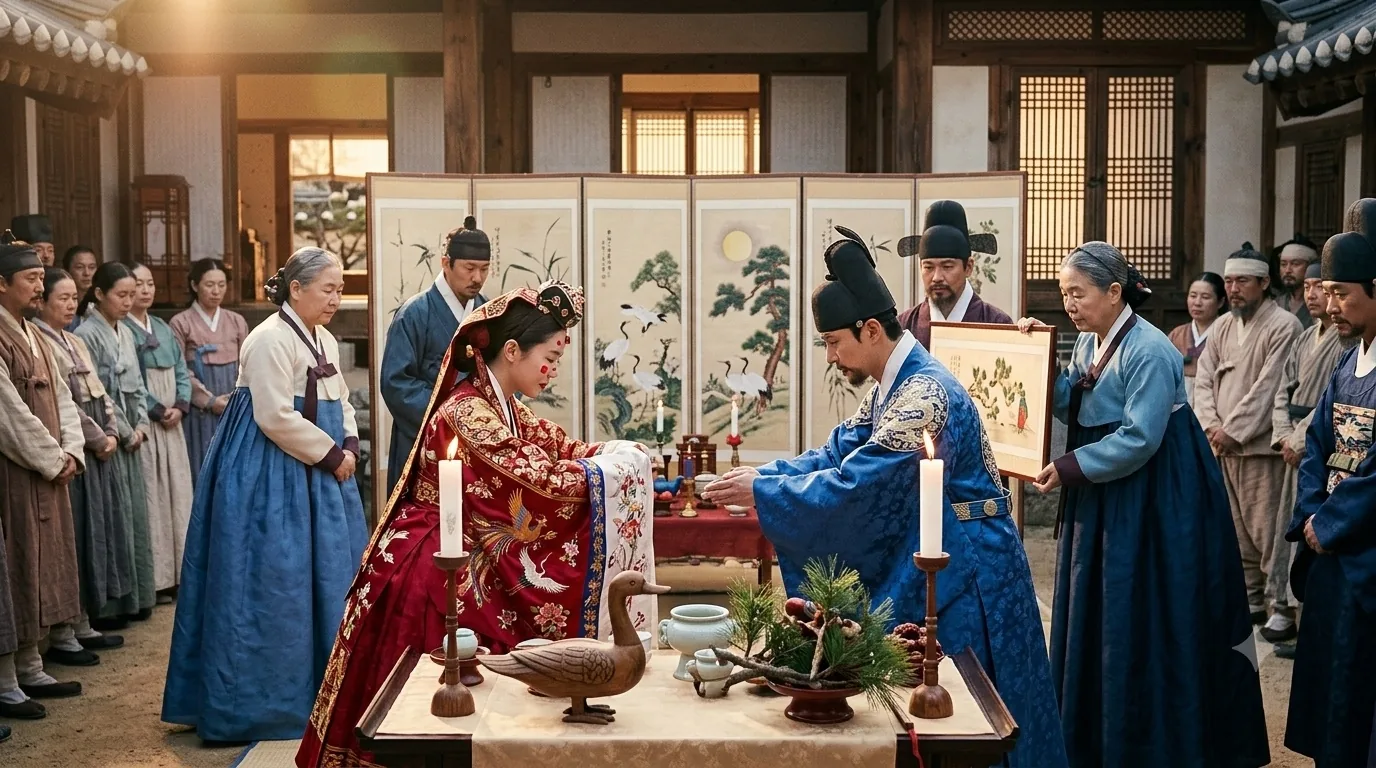
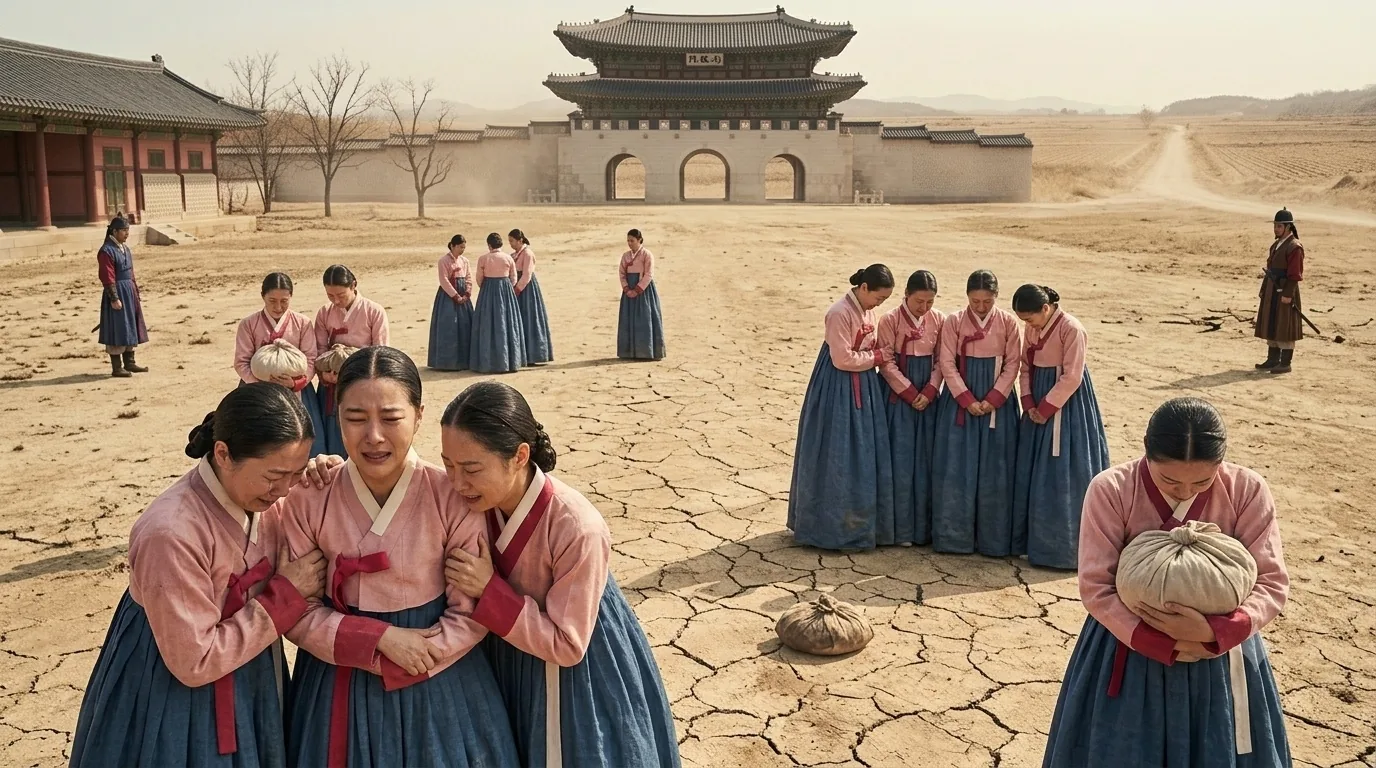
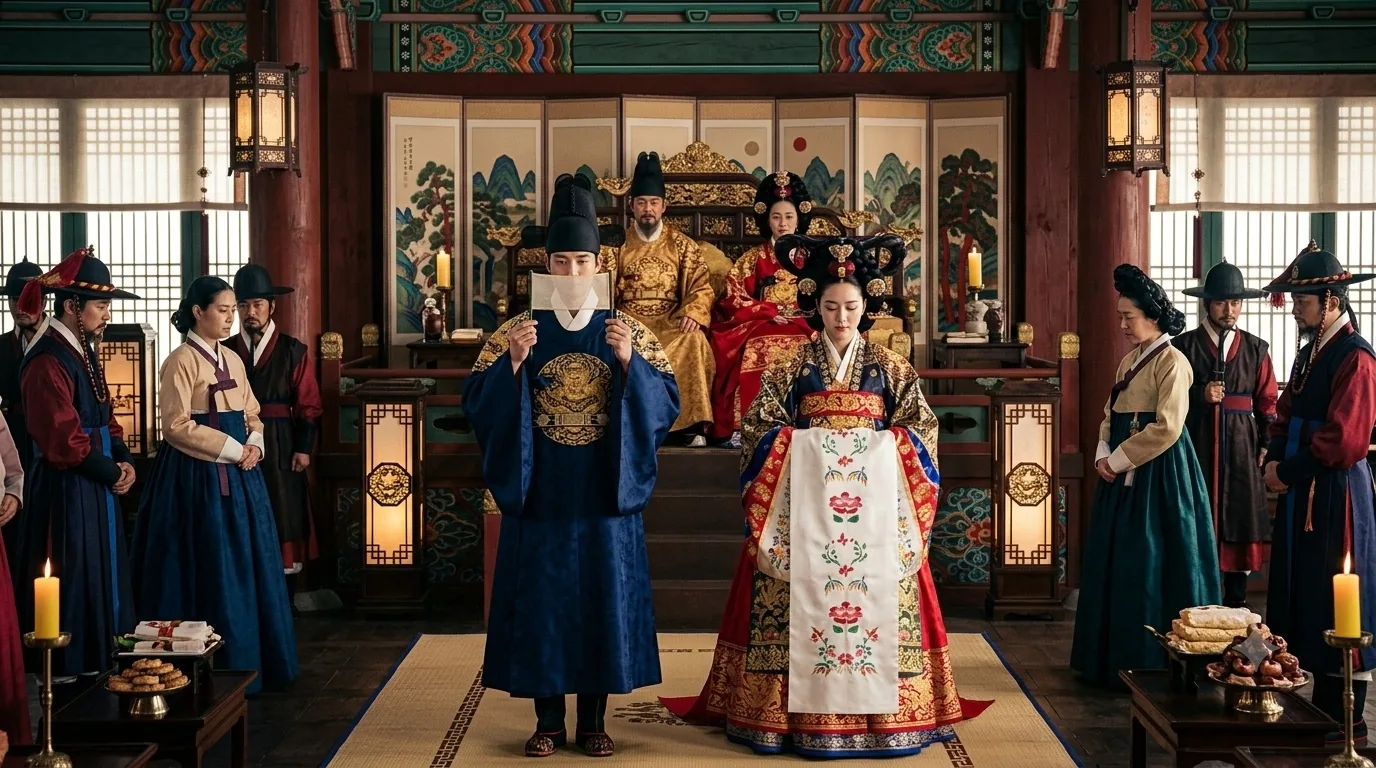
Did the Joseon Government Pay for Weddings? What the Royal Records Actually Say
From the research behind Pause the Drama.
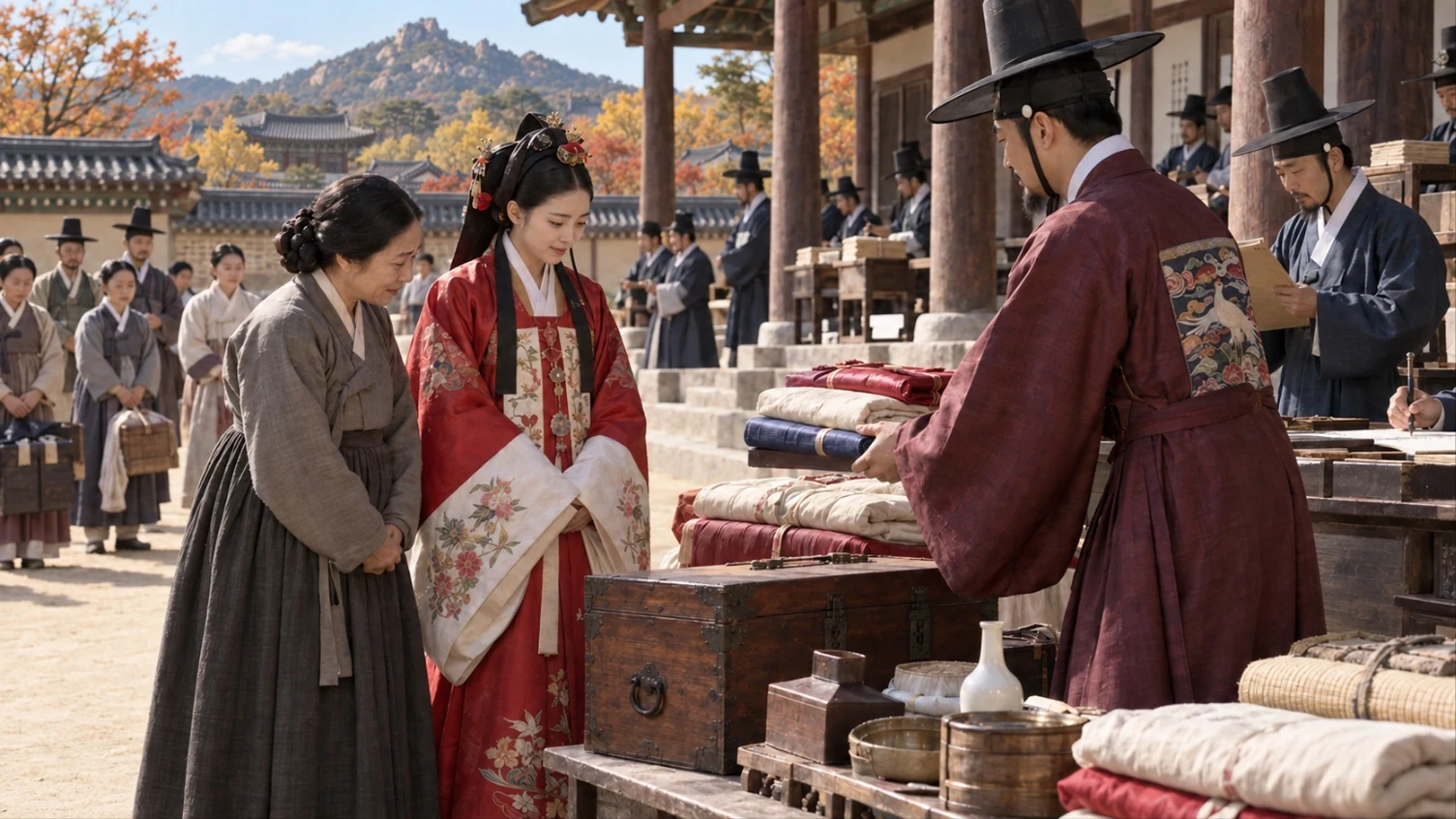 Wedding goods handed out at a government office. The records say Joseon officials supplied goods and grain for weddings, but this is not a picture of any recorded scene. (AI illustration)
Yes, in some cases. Joseon law and royal records show the state supplying grain or wedding goods when poverty delayed marriage. In 1472, women aged 25 or older who were too poor to marry could receive grain, and the Gyeongguk daejeon (the law code in its final 1485 form) supported poor daughters of sajok (scholar-official) families nearing thirty. But Joseon did not operate a standing state agency that assigned a spouse to every unmarried person. What makes the records unusual is a reason given alongside family order and poverty relief, most clearly in King Seongjong’s reign: the resentment of unmarried people was said to damage harmony and could be linked to flood and drought.
1. How does the drama show matchmaking?
In Flower Crew: Joseon Marriage Agency, a group of matchmakers called the Flower Crew, led by Ma Hoon, arranges marriages whatever a client’s age, sex or social standing. They are shown as the best matchmakers in Joseon. They settle marriage disputes, dress and groom brides and grooms, and even yangban families wait in line for their services.
The drama shows matchmaking as a glamorous private business. The Flower Crew, the Ma Hoon character and the romance and social-climbing plots involving Gae-ttong and Lee Soo are all invented.
In Joseon, though, marriage was not only a matter for individuals and their families. Government offices looked for people whose marriages had been delayed. They gave grain and goods to those who could not marry because they were poor, and they urged people to marry. In special cases, such as the 1791 wedding of Kim Hui-jip and a woman of the Sin family, the state actively helped a marriage take place. The law also provided for punishing some household heads.
There is an important limit, however. Joseon did not run a standing matchmaking agency that assigned a spouse to every unmarried person.
So why did the state go even as far as it did?
2. Why did the Joseon state get involved in marriage?
The records give several reasons at once: human relations and family order, relief for the poor, and the cost of weddings. Alongside these ran a political argument that is strange to modern readers.
In one sentence (this is a summary, not a quotation from a source): preventing disasters was one of the arguments used to justify state involvement in marriage. The resentment of people who could not marry was thought to damage harmony and upset yin and yang, and disaster could follow. In the records checked here, the argument appears in Seongjong’s reign.
That link does not rest on a single writer. It appears in a king’s order of 1477, a memorial of 1478 and a royal directive of 1491.
3. Wonnyeo and gwangbu
The records use two words for people past marriageable age: wonnyeo (怨女, unmarried women past marriageable age) and gwangbu (曠夫, unmarried men past marriageable age).
Both are classical terms found in the Mencius (「King Hui of Liang, Part II」). They refer to women and men who had reached marriageable age but had no spouse. They do not come with the popular folk meanings (“an empty house”, “resentment reaching the sky”).
In Joseon, these words became part of the language of government. A royal directive of Seongjong 22 (1491), 1st month, 6th day, contains the phrase:
人倫之道, 莫重婚聘, 帝王之政, 要無怨曠 “Of the ways of human relations, none is weightier than marriage; in a sovereign’s government, what matters is that there be no resentful women and lonely men.”
The same entry adds 「陰陽順序, 災孽不作」, “when yin and yang follow their order, calamities do not arise”, and orders officials to supply materials for weddings.
Some secondary accounts attribute this wording to Sejong’s reign, but that citation could not be verified in the Veritable Records. The wording is directly confirmed in the Seongjong entry of 1491.
4. From resentment to disaster: the argument in the records
Arranged in date order, the records show the argument in the language of Seongjong’s government as well as in one scholar’s proposal.
1477 (Seongjong 8, 4th month, 13th day). King Seongjong linked the resentment of gwangbu and wonnyeo to damaged harmony (和氣) and to flood and drought. He also complained that although the Daejeon already had a law on wedding support, the offices responsible had not reported cases and carried it out. So the law was on the books, but it was not always applied.
1478 (Seongjong 9, 4th month, 15th day). A series of portents, including a fall of “earth rain”, led the king to issue a call for advice (求言敎). Nam Hyo-on answered with a memorial of eight proposals. The first was 正婚嫁, “setting marriage right”. He proposed that anyone still unmarried at twenty (「年二十未婚嫁」) should be the responsibility of their parents, or failing them their siblings, or failing them their wider kin, and that when there was no kin at all the local office should give food and clothing so that the marriage could take place and “the resentment of living alone” would be removed. He went on (translated here from the Korean rendering):
“When the vapour of resentment disappears, yin and yang are in harmony; when yin and yang are in harmony, disasters can be prevented.”
The chain is written out in the entry: resentment removed, then yin and yang in harmony, then disasters prevented. One distinction matters here. Nam Hyo-on was a yuhak (幼學), a scholar without office, answering a royal call for advice. His memorial was a proposal. It should not be read as the state’s official policy. But it was not an eccentric private opinion either, because the king’s order of 1477 and the directive of 1491 use the same kind of argument in the voice of government.
1491 (Seongjong 22, 1st month, 6th day). The directive quoted in section 3 puts “no resentful women and lonely men”, “calamities do not arise” and officially supplied wedding materials into one text.
Palace maids and drought
A related case comes from much earlier. In 1414 (Taejong 14, 6th month, 8th day), during a great drought, King Taejong worried that young maids who had spent a long time in the palace might harbour resentment. Over his ministers’ objections, he sent some ten of them out of the palace.
The entry itself does not say they were released “to restore yin and yang”. Reading it in yin-yang terms is an interpretation. The safest way to put it is this: wedding relief and the release of palace maids can be understood within the same world of ideas, which tied the resentment of unmarried people and of women confined in the palace to harmony and disaster. The sources confirmed here do not describe the two measures as parts of one policy.
5. What the state actually did
The practice took shape as law and as administrative measures, though it was not applied evenly at all times.
The Gyeongguk daejeon. The Relief (혜휼) provision in the Rites section of the Gyeongguk daejeon says that when a daughter of a scholar-official (sajok) family is nearing thirty (年近三十) and still unmarried because of poverty, the Ministry of Rites should report to the king and supply wedding goods at its discretion.
The same provision sets a separate age for the penalty. If the family is not poor and the daughter is thirty or older (年滿三十歲以上) and still unmarried, the household head (家長) is to be severely punished (重論). Three points need care here:
- The provision carries on from “a daughter of a sajok family”. It is not about every family.
- The person responsible is the household head, not “the parents” in general. Nam Hyo-on proposed holding parents, siblings and kin responsible, but that was his proposal, not the wording of the code.
- The code orders punishment. No case of the penalty actually being carried out was identified for this article.
The 1472 order. Under Seongjong 3 (1472, 5th month, 7th day), unmarried women aged 25 and over were surveyed. Women of sajok families were given 10 seok of rice and beans in all, and 「其非士族者, 減半題給」: women not of sajok families were given half. So the Gyeongguk daejeon provision named sajok daughters, but at least one early measure (1472) also supported non-sajok women at half the rate. The history is not a simple line from “yangban only” at first to “commoners later”.
Women first, then men and women. Early Joseon laws on wedding relief and on urging marriage centred on women. In Sejong 21 (1439, 4th month, 14th day), a proposal to apply the marriage-urging law to men as well was not adopted because the State Council opposed it. The later Sokdaejeon says 「凡婚嫁過時者」, “all whose time for marriage has passed”, without limiting it to either sex. It orders the Hanseong administration and the provinces to search out such people, and in the most serious cases the Ministry of Taxation, provincial governors’ offices and county offices were to give extra support. The early period leaned toward women, but in the later period there are cases of both men and women being covered.
6. 1791: counting the marriages
In Jeongjo 15 (1791) the policy ran on a large scale in the capital. The year’s figures measure different things and should not be added together or treated as one total:
- 3rd month, 10th day: the Hanseong administration reported five unmarried people and 68 people urged to marry.
- 6th month, 2nd day: the Five Districts submitted a list headed 「勸婚男女別單」, “separate list of men and women urged to marry”, with 281 people in all. These were 281 men and women on the list. They were not 281 people who had married, and not 281 couples.
- Jeong Yak-yong’s Mongmin simseo, quoting Yi Deok-mu’s Ajeongjip, says 「勸而昏者, 無慮百數十人」: those who married after being urged numbered roughly a hundred-odd. This article does not fix that at an exact figure.
Kim Hui-jip and the woman of the Sin family
One wedding from that year left a record. It has to be told in two layers.
What the Veritable Records confirm (Jeongjo 15, 6th month, 2nd day): a marriage between the daughter of Sin Deok-bin and Kim Hui-jip was at the 議婚 stage, meaning the match was under discussion. King Jeongjo ordered the Minister of Taxation, Jo Jeong-jin, and the Seonhyecheong director (提調), Yi Byeong-mo, to provide the wedding materials and a feast and see the marriage through. He also had a writer of the royal library compose an account of it. The Veritable Records do not say whether that discussion had begun on its own before officials stepped in or was reached only through their mediation.
What the account linked to Yi Deok-mu’s 「김신부부사혼기」 (Record of the Royally Granted Marriage of Kim and Sin) adds, as summarized in the Encyclopedia of Korean Culture: Kim Hui-jip (28) and the Sin woman (21) had both missed the usual age for marriage because they were poor. Each had been abandoned by an earlier intended spouse, on the grounds that the family was of low standing or too poor. Yi Seung-hun and Yun Hyeong acted as go-betweens, officials proposed matching the two, and the two agreed. Jo Jeong-jin and Yi Byeong-mo each wrote a marriage letter and prepared the wedding goods for one side, Kim and Sin respectively. The original text in the Ajeongyugo, volume 12, was not collated for this article, so these details are the literary account’s version. They are not facts confirmed by the Veritable Records. The phrase “as if a son, as if a daughter”, which is sometimes repeated, was not found in either the Veritable Records or the encyclopedia entry and is not quoted here.
The Veritable Records write the groom’s name as 金喜集, while the Ajeongyugo tradition and the encyclopedia write it 金禧集. This seems to be a spelling difference between sources for the same man.
In one sentence (again a summary, not a quotation): when poverty was the obstacle, the state supplied what a wedding needed, and when a sajok family could afford a wedding but left its daughter unmarried past thirty, the code provided for its household head to be severely punished.
7. Drama and history: what the drama changes
Flower Crew shows matchmaking as a stylish private service. That is a different texture from the history.
Marriage negotiations in Joseon often involved go-betweens or matchmakers; in the 1791 case, Yi Seung-hun and Yun Hyeong acted as go-betweens. That does not mean Joseon had commercial matchmaking agencies like the Flower Crew. And the relief this article describes, for people who were poor and past marriageable age, was government administration, not a business. Which offices were involved depended on the period and the measure. The Ministry of Rites, the Hanseong administration, the Ministry of Taxation and local offices all appear. The Sokdaejeon links searches by the Hanseong administration and the provinces with support from the Ministry of Taxation. The involvement of the Seonhyecheong director belongs to the special 1791 wedding and should not be read as a permanent part of the system.
The drama’s matchmakers deliver romance and social climbing. The state’s wedding relief was a measure of government rather than a modern love-and-welfare service. Human relations and family order, poverty relief and political ideas about yin and yang and disasters worked together in it.
8. What surprises modern readers
First, the law targeted the household head, not the unmarried person. Under the Gyeongguk daejeon, if a sajok family was not poor and its daughter reached thirty or older without marrying, the household head was to be severely punished. That is a rule on paper. No record of it being enforced was confirmed here.
Second, the Gyeongguk daejeon provision named daughters of sajok families, yet a 1472 order also gave half the support to women who were not sajok.
Third, weather and disaster sat among the reasons. Next to family order and poverty relief, King Seongjong and at least one scholar, Nam Hyo-on, argued that the resentment of the unmarried could damage harmony and bring flood and drought. To modern readers this is the least familiar part of the story.
9. Political and social meaning
In Confucian kingship, the ruler was responsible for the people’s lives, and good government was thought to connect with the order of nature. Joseon’s theory of portents held that the people’s grievances and the government’s faults could damage harmony and be linked to disaster. The marriage sources confirmed for this article make that link clearly for the resentment of unmarried people. This article did not examine whether the same sources extend it to famine or wrongful imprisonment.
The four “most wretched” groups (四窮) of Confucian relief were 鰥寡孤獨: widowers, widows, orphans and the childless elderly. The Mongmin simseo defines them this way. The sources do not put unmarried men and women into that legal category. The link is broader: both belong to the Confucian idea that a king had to care for people with no one to rely on.
10. A literary source: 「Nocheonyeoga」
A late Joseon gasa (a sung verse form), 「노처녀가」 (Nocheonyeoga, “Song of an Old Maid”), survives. In one well-known line of versions, an unmarried woman of a yangban family laments her situation. It is a literary work, not the true story of a particular person. It survives in several variant texts whose contents differ, so not every version should be read as the same yangban woman’s story.
One possible reading is that in a society where marriage mattered enough for the state to step in, the plight of someone who had missed the age for marriage was keenly felt, and that this may be why such songs were written and passed down. That is a guess, not a documented fact.
11. How unusual was Joseon’s policy?
Other states also intervened in marriage, and their aims overlapped with Joseon’s. The age norms Joseon cited came from Chinese Confucian ritual: Zhu Xi’s Family Rituals (volume 3, 「議昬」) gives 16 to 30 for men and 14 to 20 for women, and the Sejong 9 (1427) entry quotes it almost word for word, as does a Sejong 22 (1440) entry. The terms wonnyeo and gwangbu, and the idea of portents, also came from Chinese classics and Confucian political thought.
Further afield, Augustus’s marriage laws (the Lex Iulia de maritandis ordinibus of 18 BC and the Lex Papia Poppaea of AD 9) penalized the unmarried and childless in inheritance, and Fascist Italy taxed bachelors as part of population policy (see Enrico Rubolino, CESifo Working Paper No. 11998, 2025).
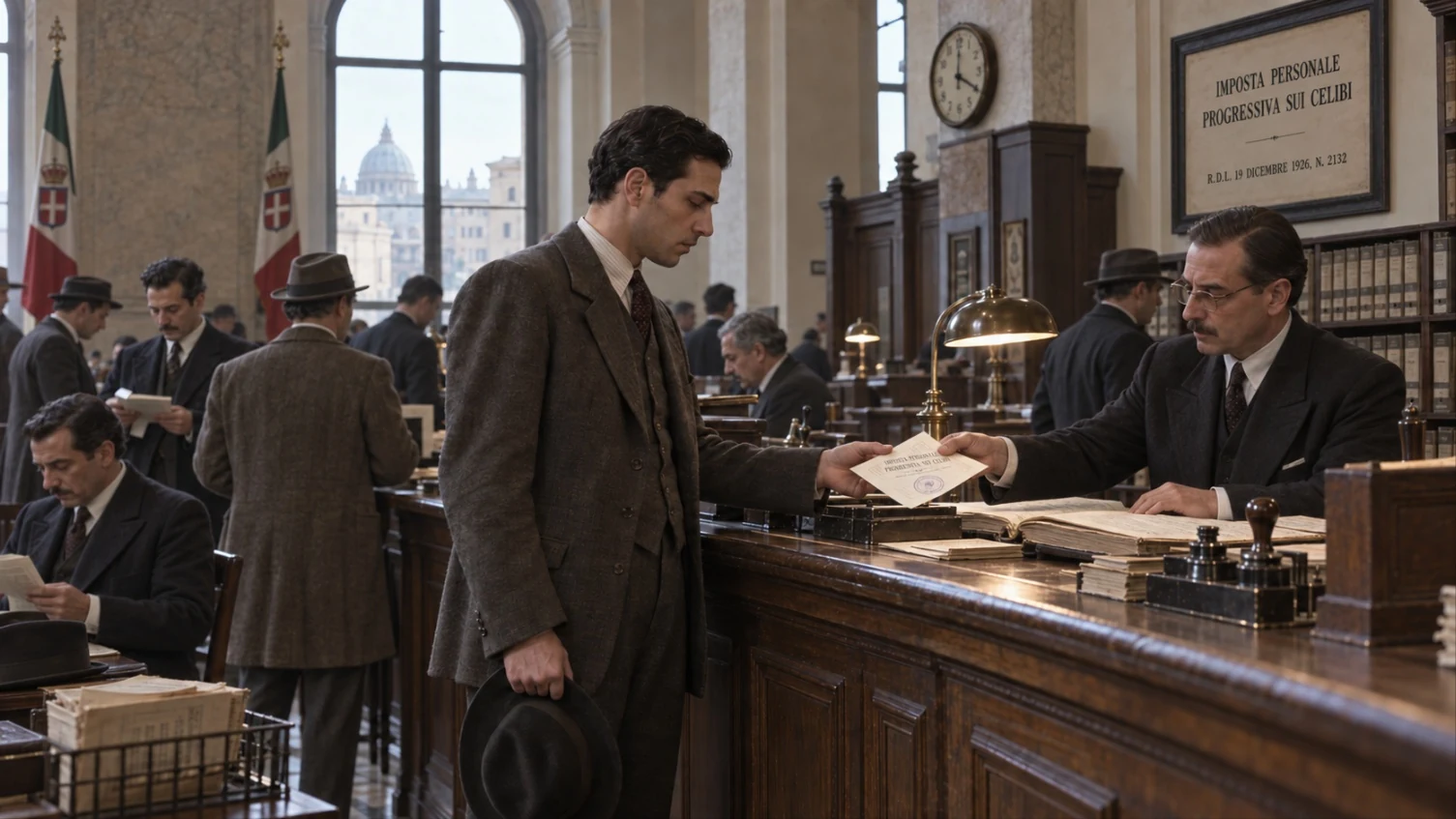 A tax office in Fascist Italy, which taxed bachelors. The lettering in the picture is part of the illustration and was not checked against any document. (AI illustration)
What stands out in the Joseon records is not intervention as such but the political language around it: delayed marriage was handled as relief administration, and it was also explained in terms of resentment, yin and yang, and disaster.
12. Back to Flower Crew
The drama’s matchmakers are romantic helpers who bring couples together. Behind that picture lies a less familiar history.
In Seongjong’s reign especially, a wedding could be part of the state’s response to portents. In 1478, for example, a memorial answering a call for advice after portents proposed ending the resentment of the unmarried as a way to restore harmony. Seen together, these records show a political world in which unresolved human resentment could be discussed alongside harmony and natural disaster. Officials surveyed delayed marriages and supplied wedding goods; in a separate 1414 drought episode, Taejong also released palace women because he feared their resentment.
Flower Crew is a romantic comedy. The history behind it is stranger.
In one sentence (a summary, not a quotation): in Seongjong’s reign especially, the records treated unresolved marriage as a matter of government and tied it to yin, yang and disaster.
This article was researched and written by K-Drama History. Source: Did the Joseon Government Pay for Weddings? What the Royal Records Actually Say — K-Drama History