MAL·MO·E, Explained: Korea's Dictionary Was a Crime — and the Woman at the Centre of the Famous Origin Story Said It Wasn't True
Theme: Knowledge & Science
From the research behind Pause the Drama.
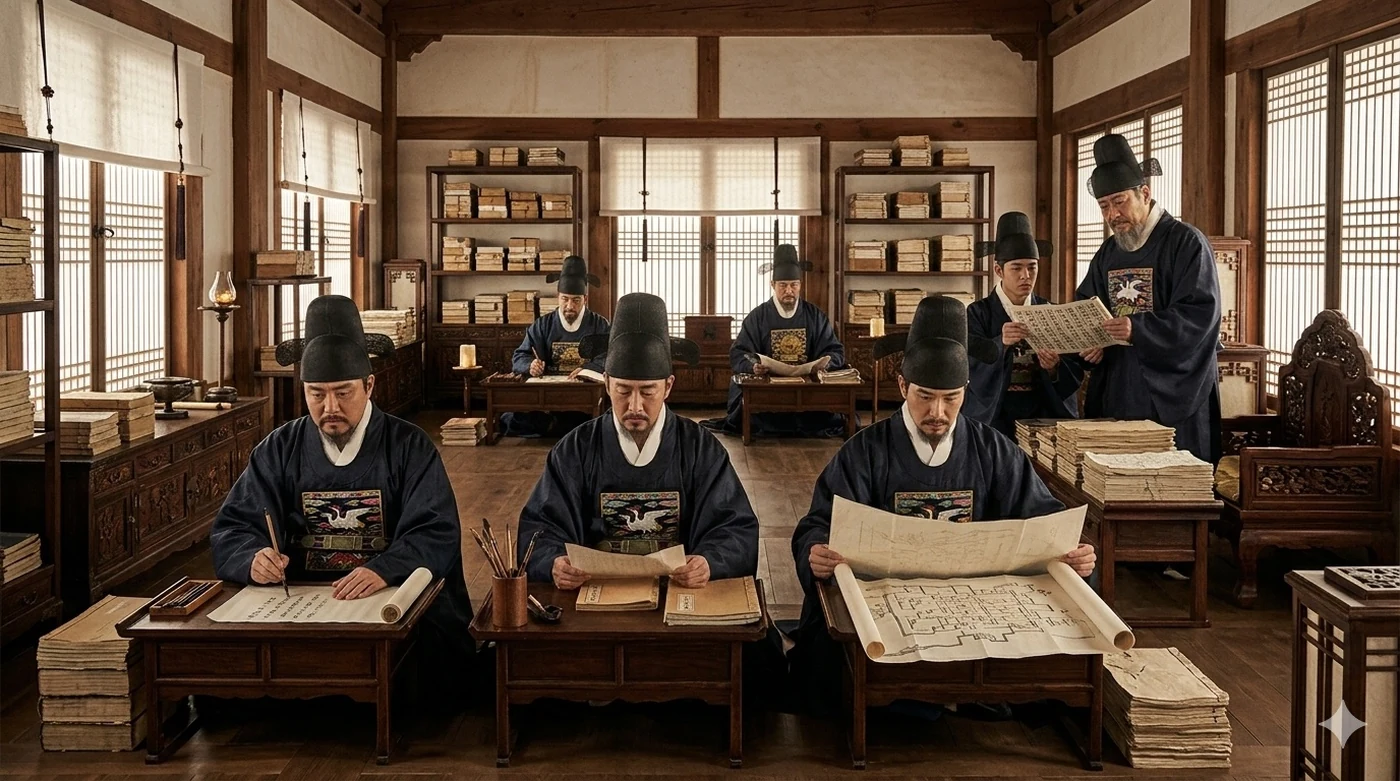
There is a scene in MAL·MO·E: The Secret Mission (말모이, 2019) that looks like nothing. Men sit in a bookshop basement sorting slips of paper. No weapons, no strategy, no chase. Just paper, brushes and people. If it feels slow, that is the point — it is roughly the actual speed of the work.
The film is about compiling a Korean dictionary under Japanese colonial rule, and the question it raises for viewers outside Korea is usually the same one. Hangeul, the Korean alphabet, was created in the fifteenth century. Why was anyone still making a dictionary in the twentieth — and why would that be worth a prison sentence?
The answers are good ones. But the most repeated answer, the one that circulates in articles and summaries, has a problem: the woman at the centre of it said it was not true.
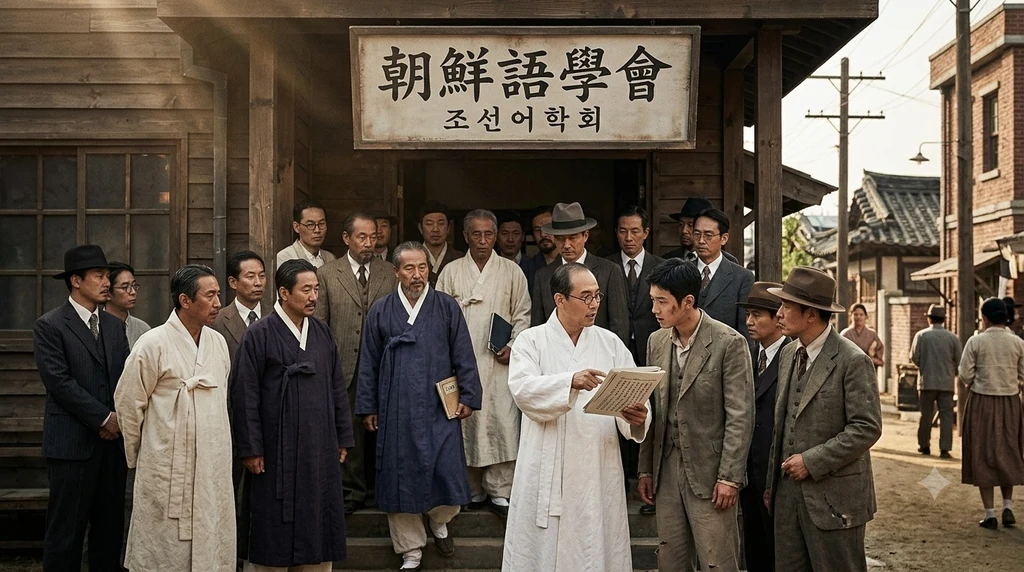 The Korean Language Society. The work was paper, brushes and people — and the state read it as an independence organisation. (AI illustration)
The story everyone tells
Here is the version you will find almost everywhere. In 1942 a student at Yeongsaeng Girls’ High School in Hamhung wrote a line in her diary — that she had been scolded for using gugeo, “the national language”. Under colonial rule gugeo meant Japanese. The police read the line, worked backwards, and the investigation unspooled into the Korean Language Society.
It is a wonderful hook. A dictionary case that begins with a schoolgirl’s sentence.
In 1998 the National Institute of Korean Language published a roundtable in its journal Saegugeo Saenghwal, gathering former Yeongsaeng students to remember their teacher Jeong Tae-jin. Among those present was Park Yeong-hui — the student usually named in the story.
The section heading is “the fiction of the diary origin.”
What she describes is different. A slogan had been posted in the school ordering the use of Japanese; one day it was found turned upside down, and that was what caused trouble. Of the reported diary line she said the newspaper accounts had differed from what they lived through, and that the diary did not say what it was later reported to say. She was also blunt that the connection drawn to her teacher was imposed after the fact.
The official record is unsettled in a smaller way too: the National Institute of Korean History names the student Park Yeong-hui, while the Encyclopedia of Korean Culture gives a different name and no diary at all, describing instead students overheard speaking Korean.
What is firmly established is narrower and less cinematic. Jeong Tae-jin was taken in on 5 September 1942, and his interrogation is what opened the path to the Society. On 1 October the core members were arrested in numbers.
We are keeping the diary story in this article rather than quietly dropping it, because the shape of the error is worth seeing. A film invents an informant and calls it a film. Popular history invents a diary and calls it history.
The colonial government published a Korean dictionary too
Now the more interesting fact, and the one that reframes the whole case.
Japan did not simply forbid Korean. The Government-General of Korea published its own Korean dictionary in 1920 — the Joseoneo sajeon, issued through its Central Council (中樞院, Jungchuwon), the advisory body attached to the colonial administration. The Hangeul Society, describing the materials its own compilers drew on, characterises it as a lexicon organised with Japanese glosses, and mentions in the same breath James Gale’s 1897 Korean–English dictionary, organised with English glosses.
This makes sense once you think about what an occupying administration needs. To govern, you must understand what is being said. To understand, you need a lexicon. A Korean–Japanese wordlist is an instrument of administration.
A dictionary that explains Korean in Korean is a different kind of object. It treats the language as a complete system rather than something to be rendered into another language.
That distinction is real, and it is the most useful thing this story has to offer a reader who has never thought about lexicography. But it should not be stretched into a single-cause explanation of the arrests, because the record does not support that — as the court documents show.
What the court actually wrote down
The charge was violation of the Peace Preservation Law, the statute used for thought crime. The specifics are where the compression usually happens.
The National Institute of Korean History records that the police regarded the Society’s entire programme as criminal: the dictionary project, the unified orthography, loanword transcription rules, touring lecture courses, the Hangeul Day commemorations, and its reprints of classical texts. Not the dictionary alone.
The reasoning survives in the preliminary examination documents. The prosecution’s theory was that independence would be secured through cultural work — that the Society had adopted language activism as its method and was operating, in the document’s own phrase, under “the mask of a cultural movement” as a body building practical capacity for independence. The same text calls the dictionary project a national undertaking of rare scale.
A 1944 preliminary decision put it in terms that read almost as praise: language work was “a cultural national movement and at the same time the most far-sighted, gradualist form of a movement for national independence.”
The interrogation questions recorded in the National Institute of Korean History’s database are plainer still. What is the purpose of compiling this dictionary? Is the compilation of a Korean dictionary not aimed at future Korean independence? In an age when Japanese is used, is researching and spreading Hangeul not an attempt at independence?
So the accurate formulation is this: the state did not prosecute a dictionary. It prosecuted an organisation, and the dictionary was the largest thing that organisation was doing.
Thirty years, three generations
The film’s title names a real book. Malmoe — “a gathering of words” — was begun in 1911 at the Joseon Gwangmunhoe, founded by Choe Nam-seon, with Ju Si-gyeong and his students Kim Du-bong, Gwon Deok-gyu and Yi Gyu-yeong.
It was never finished. Ju died in 1914. Kim Du-bong went into exile after the March First Movement. Yi Gyu-yeong died in 1920. One volume survives at the National Hangeul Museum, designated a national treasure in 2020.
The work resumed under different hands. A dictionary compilation society was launched on Hangeul Day 1929, and before a dictionary could exist the language needed settled rules. The Korean Language Society issued the Unified Hangeul Orthography in 1933, the Standard Korean Word Collection in 1936, and unified loanword transcription rules in 1940. The backbone of modern Korean spelling was built in those years.
The vocabulary itself was gathered by post. Readers of the journal Hangeul and students going home for the holidays were asked to write down the words of their own districts. The film’s dialect-collection scenes have a basis here. The Society had neither the money nor the staff to send trained surveyors.
That method is often described as charmingly amateur. It is better described precisely: professional compilers handled headword selection, definitions, editing and grammatical systematisation, while readers and students supplied regional vocabulary. A distributed collection effort feeding a specialist editorial core — which is also why the arrests reached so far.
Meanwhile the ground was closing. The Third Korean Education Ordinance of 1938 pushed Korean from required to elective. Korean-language newspapers were shut in August 1940. By the wartime years Korean had been progressively pushed out of schooling, though the picture varied by school level and the gap between what regulations permitted and what actually happened in classrooms was real.
The numbers do not agree, and that is worth saying
How many were taken? Official sources differ, and rather than average them, here is the spread.
| Source | Detained | Not detained | Total | Witnesses | Indicted |
|---|---|---|---|---|---|
| Sinpyeon Hanguksa (NIKH) | 29 | 4 | 33 | 48 | 16 |
| Encyclopedia of Korean Culture (AKS) | 29 | 4 | 33 | 48 | 16 |
| Korean History Timeline (NIKH) | — | — | 31 | — | 16 |
| Korean History Database (NIKH) | — | — | — | “about 50” | 29 |
| The Society’s own public statement, October 1945 | — | — | 32 | — | — |
Two accounts agree exactly; a third from the same institute says 31; a fourth, by a different author in the same institute’s database, gives 29 indicted and 13 sent to trial. And the earliest source of all — the Society’s own account of the affair, published in Maeil Sinbo on 10 October 1945, weeks after liberation — says that “a total of 32 were arrested by the Hongwon police station.”
Much of the variation appears to come from what each source is counting — those held, those questioned, those charged — rather than from any disagreement about whether the arrests happened.
The confiscated manuscript has the same problem. Figures circulate for how many sheets were seized, but the Hangeul Society’s own account does not give a seizure total. What it records instead is the state of the work in September 1942: definitions completed for roughly 160,000 entries, with about 5,000 outstanding.
Two men died
Sixteen were indicted and twelve given suspended indictment. Yi Yun-jae died on 8 December 1943. Han Jing died on 22 February 1944. Both in Hamhung prison.
Official Korean historical accounts connect their deaths directly to the torture and imprisonment — the National Institute of Korean History writes that they died in prison after being tortured. Accounts that add a record cold winter as a contributing factor are not carried by the official record.
The cruellest detail comes at the end. Those given custodial sentences appealed to the Gyeongseong High Court. The appeal was dismissed on 13 August 1945 — two days before liberation. They were released on 17 August.
The manuscript came home before the men did
The film’s second half is about moving and hiding paper. People matter, but paper moves first. In the actual history the people and the manuscript travelled separately and survived separately.
Seized as evidence, the manuscript disappeared into the machinery of the case. After liberation, when people gathered again at the Society, it was not there. It was eventually found in a warehouse at Gyeongseong Station — today’s Seoul Station — where it had ended up after being sent as trial evidence to the High Court.
The date is not settled. The Hangeul Society’s own account says 8 September 1945; the National Institute of Korean History’s timeline says October. Descriptions of a crate addressed to the High Court circulate widely but are not in the official accounts, so we leave them out.
From that manuscript the first volume appeared on Hangeul Day, 9 October 1947. The Korean War interrupted the work again. The set was completed in six volumes on Hangeul Day 1957 — twenty-eight years after the compilation society was founded.
The book changed names along the way, which is worth getting right. When the Society applied for publication permission in March 1940 the proposed title was Joseoneo daesajeon. The postwar volumes appeared as Joseonmal keunsajeon, and from 1950 the printings dropped “Joseonmal” and carried the title Keunsajeon. The renaming happened in 1950, at the third volume — not at completion in 1957.
They died making a dictionary, and the dictionary survived in a railway freight warehouse.
Compared: other languages under pressure
Korea’s case is often set beside three others. The comparisons are useful, but each is usually flattened into a single villain, and that flattening is worth resisting.
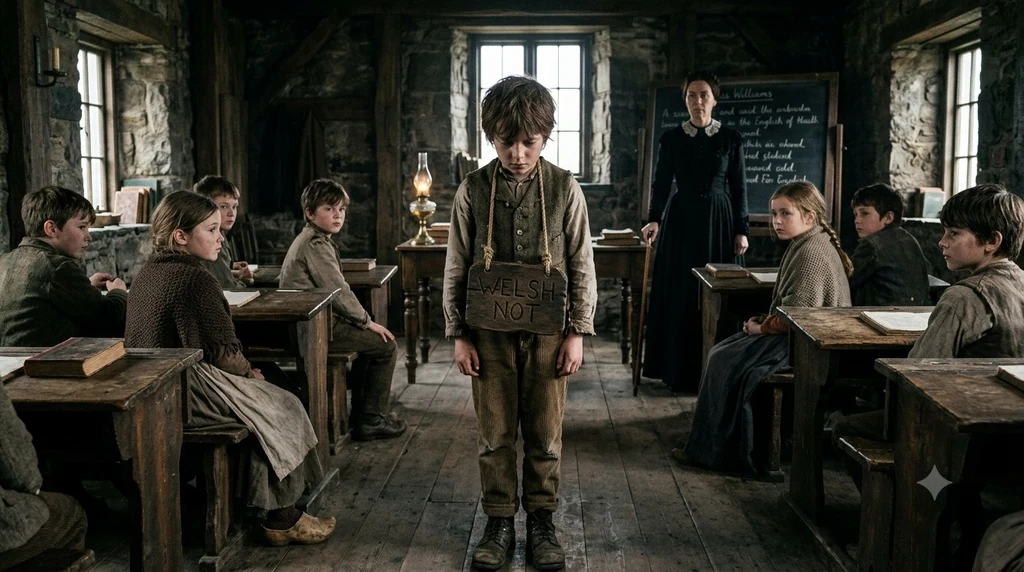 The Welsh Not: a board passed from child to child, with the one wearing it at day’s end punished. (AI illustration)
Wales. Nineteenth-century Welsh schools used an object called the Welsh Not — a piece of wood hung around the neck of a child caught speaking Welsh, passed on to the next offender, with the child wearing it at day’s end being punished. Martin Johnes’s research treats it as a practice operated by schools and teachers rather than a uniform government mandate, and it was not applied the same way everywhere. But it did not float free of policy either: an education system and broad social pressure toward English stood behind it. So the contrast with Korea is not simply “teachers versus a state” — it is a difference in how directly the state’s hand appears.
Catalonia. After Franco’s victory in 1939, Catalan was severely restricted in public life, education and publishing, particularly in the early years of the regime — the intensity was not constant across the whole period. Pompeu Fabra, who established the modern orthographic standard and produced a Catalan dictionary in 1932, left for France on 31 January 1939, five days after Barcelona fell, and died in exile in 1948. This is the closest analogue to the Korean Language Society, and it differs in one decisive respect: Fabra crossed a border and survived. Yi Yun-jae and Han Jing died in prison. Korean exile was possible — the record of Koreans fleeing to Manchuria, China and Russia is extensive, and Kim Du-bong of the original Malmoe project did exactly that — but these two men were already in custody when it mattered.
Israel. Eliezer Ben-Yehuda spent his life compiling a dictionary for a language that was not in everyday spoken use, though Hebrew had continued as a language of religion, literature and study. The first volume appeared in 1908; after his death in 1922 the work was carried on by his family and by later editors and scholars, and completed in 1959. The revival of modern Hebrew came from dictionaries, schooling, press, language institutions, immigrant communities and daily use together — not from one man. It is the mirror image of the Korean case: there a dictionary helped bring a language back into daily life; here a dictionary was made to hold one in place.
Set against these, what stands out in Korea is scale and organisation on both sides. The state acted through education ordinances; the response was not an individual but an institution — and around it, readers and students posting words in from their home districts.
Back to the film
At the end of MAL·MO·E, the completed dictionary is handed to Kim Pan-su’s children. Their father had been learning to read; they receive a book made of that reading.
Kim Pan-su never existed, so the scene is invention. What is not invention: two men died, the dictionary was finished, and it was received by the next generation.
From Ju Si-gyeong’s first entries in 1911 to the final volume in 1957 is forty-six years — understood as the long arc of a project that stopped, changed hands and restarted, not one unbroken effort. Two men died in prison along the way. And the manuscript spent the end of the war in a railway warehouse, waiting for a country that could publish it.
The film gets one thing exactly right, and it is the thing most easily missed. The people who made this dictionary were not only famous scholars. They were also students on holiday, writing down the words their grandmothers used and posting them to Seoul. When the police came, they came for all of it.
This article was researched and written by K-Drama History. Source: MAL·MO·E, Explained: Korea's Dictionary Was a Crime — and the Woman at the Centre of the Famous Origin Story Said It Wasn't True — K-Drama History