The Great Battle, Explained: Was Yeon Gaesomun a Villain or a Defender of Goguryeo?
From the research behind Pause the Drama.
The villain of The Great Battle (안시성, 2018) is not only Tang Taizong. Goguryeo’s real power, the Great Makriji Yeon Gaesomun (played by Yu Oh-seong), gives a secret order to Samul (Nam Joo-hyuk), a young warrior from the Taehak academy: go to Ansi Fortress and eliminate its commander, whom the film calls Yang Manchun (Zo In-sung). Yeon’s side denounces Yang as a traitor who gave no help at the battle of Jupilsan.
A huge Tang army is on its way, and the man running the country wants the general holding the border dead. Viewers leave the film sure that Yeon Gaesomun is the villain. So did the film invent this conflict? And was he really a villain?
Half of it is invented. A secret assassination order in the middle of the war does not appear in the major surviving accounts consulted for this article; it is the film’s own device. But a rift between the two men is reported. Just before attacking Ansi, Tang Taizong is recorded as saying that he had heard the commander of this fortress refused to submit during Yeon Gaesomun’s coup, and that Yeon had attacked him, failed to take the fortress, and left him in charge of it.
Ansi, the fortress that held off Tang Taizong, was also, according to what the Tang emperor said he had heard, a fortress that Yeon Gaesomun had failed to take a few years earlier.
And this villain was both a ruler who killed his king and a man who held power through every Tang invasion of his lifetime, none of which conquered Goguryeo.
Quick answer: Did Yeon Gaesomun order the Ansi commander’s assassination? That is the film’s device; it does not appear in the major surviving accounts consulted for this article. Did Ansi resist Yeon Gaesomun? Tang Taizong is recorded as saying he had heard so: that the commander refused to submit after the coup of 642 and that Yeon attacked but could not take the fortress. No Goguryeo record independently confirms it. Was Yeon a villain or a defender? He killed King Yeongnyu in 642, and Goguryeo was not conquered by Tang during his lifetime; it fell in 668, after his death and amid a succession struggle among his sons. Both facts have to be read together.
Let’s unpack it.
1. How did Yeon Gaesomun come to power?
Yeon Gaesomun (淵蓋蘇文, d. 666; other death years are also proposed) did not rise from nothing. According to the epitaph of his son Cheon Namsaeng (泉男生), his grandfather Jayu and his father Taejo both held the office of makriji (莫離支), one of the highest offices in Goguryeo. He was the heir of an aristocratic family that had held power for generations.
Taking over his father’s position still wasn’t easy. When his father died, aristocratic opposition made the succession difficult. The biography in the Samguk sagi says he was allowed to inherit only after he bowed his head, apologized, and promised that they could remove him if he did wrong.
In the first month of 642, King Yeongnyu put him in charge of work on the Cheolli Jangseong, the “Thousand-li Long Wall” (王命西部大人蓋蘇文, 監長城之役). Construction of this frontier defense line began in 631 under King Yeongnyu, and the Samguk sagi says it took sixteen years to finish. Historians read the appointment in two ways. One view sees it as a demotion by rivals who wanted him away from the capital. The other sees it as a result of the Yeon family having led the wall project all along.
The coup came that winter, in the tenth lunar month. According to the Samguk sagi, the king and his ministers had plotted to kill him, and the plan leaked. Yeon Gaesomun gathered the troops he could mobilize, the bubyeong (部兵), as if for a review. He set out lavish food and wine south of the city and invited the ministers. When the guests arrived, he had them all killed, about a hundred men. He then entered the palace and killed King Yeongnyu.
The date and the death toll differ by source. The Samguk sagi annals place the coup in the tenth month of 642. The Zizhi Tongjian records it in an entry for the eleventh month of the same year. The Nihon shoki, relying on a report from Goguryeo envoys, dates it to the ninth month of 641 and puts the dead at more than 180. This article does not merge the three.
The murdered king was no coward. In 612, when a Sui fleet attacked Pyongyang, Yeongnyu, then the king’s younger brother, led a band of picked men into battle. Many historians argue that the coup grew out of two things at once: the foreign policy of a war-tested king who chose to coexist with Tang, and the struggle between royal and aristocratic power.
Yeon Gaesomun did not make himself king. He put Yeongnyu’s nephew on the throne as King Bojang and ran the country as makriji. He killed a king but kept a king of the Go royal house in front, and kept the sword in his own hand.
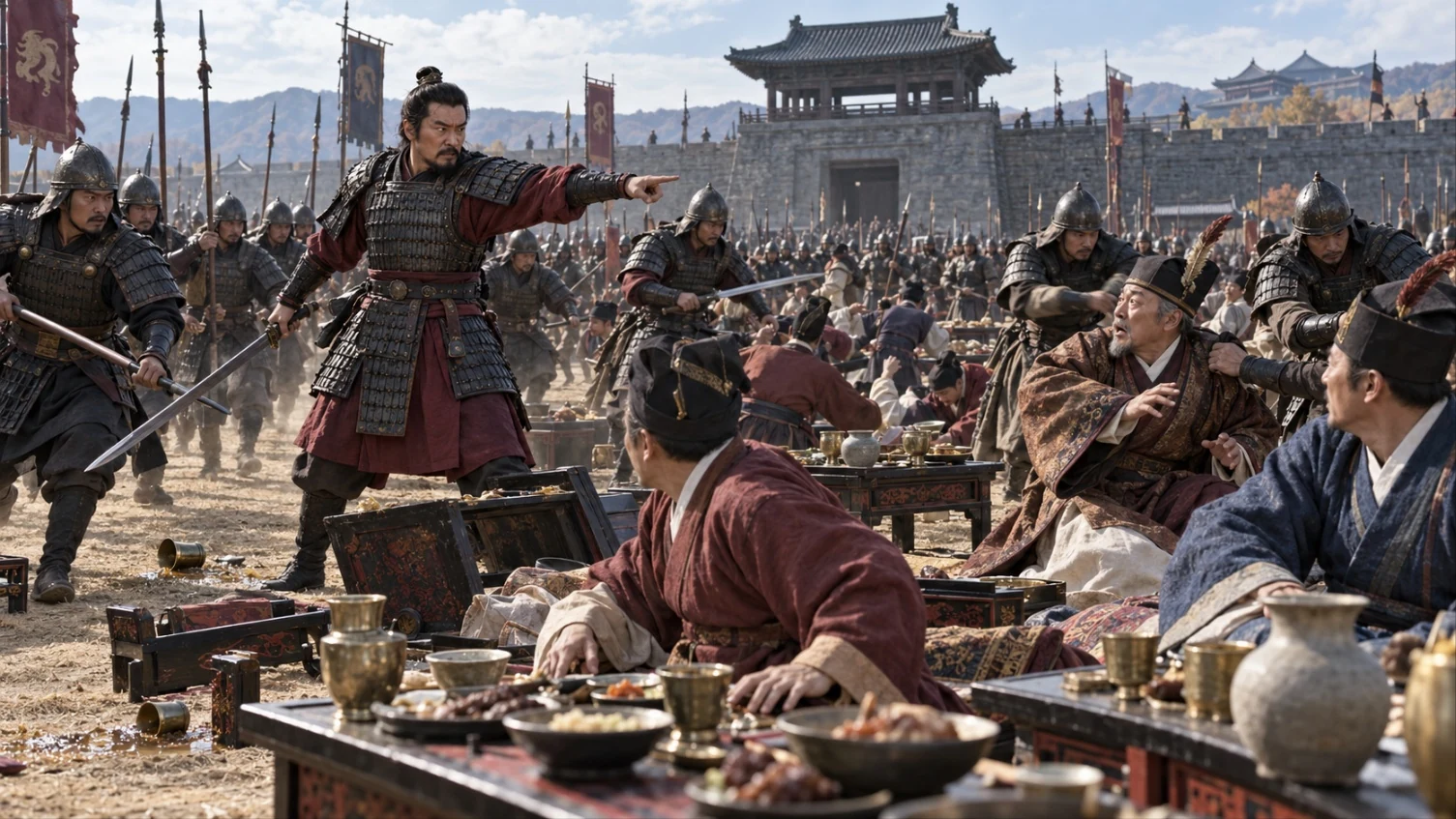 The banquet of 642 as the Samguk sagi describes it: the ministers invited south of the city, then killed. (AI illustration)
2. Why is the film’s Yang Manchun Yeon Gaesomun’s enemy?
In the film, Yeon’s side brands Yang Manchun a traitor and tries to remove him. The line this idea grows from was spoken by an enemy emperor.
According to volume 198 of the Zizhi Tongjian, after taking Baegam Fortress in 645, Tang Taizong said this to his general Li Shiji: Ansi is rugged, its soldiers are elite, and its commander is talented and brave. During the makriji’s rebellion, he held the fortress and did not submit (莫離支之亂, 城守不服). The makriji attacked him but could not take it (莫離支擊之不能下), and so left it to him (因而與之). Volume 21 of the Samguk sagi records the same passage. In both texts, the emperor introduces this as something he had heard.
Taken at its word, this means that after the 642 coup, Yeon Gaesomun’s regime did not control every provincial fortress. At least at Ansi, it could not win by force and chose to recognize the commander. But this is information the Tang emperor had heard secondhand, and both texts belong to the same line of transmission. No Goguryeo record independently confirms it.
There is one more twist. The emperor who said this wanted to avoid Ansi himself. He proposed attacking Geonan Fortress first, which had weaker troops and less grain. Li Shiji objected: all their supplies were in Liaodong, so what would they do if they bypassed Ansi and their supply line was cut? Taizong followed his advice, and the Tang army came to a halt in front of the very fortress the emperor had wanted to skip.
The biggest difference from the film is how the rest of Goguryeo acted during the war. In the record, Goguryeo did not abandon Ansi. When the Tang army reached Ansi, Go Yeon-su and Go Hye-jin, the yoksal (褥薩, regional military governors) of the northern and southern districts, marched to its relief with more than 150,000 Goguryeo and Mohe troops. That relief army was defeated at Jupilsan, and Go Yeon-su and Go Hye-jin surrendered with 36,800 men (延壽、惠眞帥其衆三萬六千八百人請降). This is the Jupilsan defeat at the start of the film. But where the film appears to put Yeon Gaesomun on that battlefield himself, the record names Go Yeon-su and Go Hye-jin as the relief army’s commanders.
The reason the Tang army withdrew is also different. The film makes the arrival of Yeon Gaesomun’s relief army the decisive blow. The record says that in Liaodong the cold came early, the grass withered, the water froze, and supplies were running low, so Taizong ordered a withdrawal.
Even the commander’s name is a twist. In the Samguk sagi passage above, the emperor speaks only of “its commander” (其城主); no name is given. Kim Busik, who compiled the Samguk sagi, wrote in his historian’s commentary that the name of Ansi’s commander had not come down in the histories. Scholarly studies of the name find that “Yang Manchun” appears in the Ming-dynasty work Tangshu zhizhuan tongsu yanyi (唐書志傳通俗演義), and that the early tradition writes it 梁萬春, not the 楊萬春 used today. According to Nam Jae-cheol’s study, the earliest surviving edition dates from 1553, but because that edition was compiled from earlier material, neither the person who first coined the name nor the date can be determined. The same research concludes that earlier works such as the Yeodong seorok are hard to treat as a firmly earlier source. So the name of one of Korea’s best-known resistance heroes traveled through a Chinese text, and even its written surname changed along the way. How the name spread in Joseon is covered in Section 7.
Ansi, the fortress that held off Tang Taizong, was also, according to what the Tang emperor said he had heard, a fortress that Yeon Gaesomun had failed to take a few years earlier.
3. So what did Yeon Gaesomun defend?
As the Jupilsan defeat at the start of the film shows, the war of 645 was bitter for Goguryeo. Its strongholds toward the Liao River, including Liaodong and Baegam, fell one after another. But Tang could not get past Ansi, and it failed to conquer Goguryeo.
Yeon Gaesomun also fought off the battlefield. Volume 198 of the Zizhi Tongjian records that after the Jupilsan defeat, the makriji worked through the Mohe (莫離支使靺鞨…) to persuade Zhenzhu Khagan of the Xueyantuo (薛延陀), a nomadic power north of Tang, to move, tempting him with large rewards. The khagan was afraid and did not dare to act (啗以厚利, 眞珠懾服不敢動; part of the reading is not settled, and the standard edition has not been checked). Scholars still debate whether this northern maneuver affected the Tang withdrawal.
The invasions continued. In 661–662 a Tang army came as far as Pyongyang. The Samguk sagi records that the Tang general Pang Xiaotai fought Yeon Gaesomun at the Sasu River (蛇水), that his entire army collapsed, and that he was killed along with his thirteen sons.
During the twenty-odd years Yeon Gaesomun held power (roughly 642–666), Tang invaded several times but did not conquer Goguryeo. Goguryeo fell in 668, after his death and amid a succession struggle among his sons. Sources and interpretations disagree on his death year: 666 (the Samguk sagi and Chinese histories), 665 (an interpretation based on when his son Namsaeng succeeded him, as recorded in Namsaeng’s epitaph), and 664 (the Nihon shoki).
Yeon Gaesomun was a ruler who killed his king, and also the man who held power through every Tang invasion of his lifetime, none of which conquered Goguryeo. Keep only one side and he cannot be explained.
4. Where do the film and the record part ways?
| The Great Battle (film) | The record |
|---|---|
| The film appears to place Yeon Gaesomun on the Jupilsan battlefield in person | The relief army was commanded by Go Yeon-su and Go Hye-jin, military governors of the northern and southern districts |
| Yeon Gaesomun sends Samul to eliminate Yang Manchun | No assassination order appears in the major surviving accounts consulted for this article. What survives is Tang Taizong’s recorded remark that he had heard the commander refused to submit during the coup, and that Yeon attacked but could not take the fortress |
| Yang Manchun is accused of not helping at Jupilsan | A relief army of more than 150,000 under two regional military governors marched to Ansi. The record gives no reason why the commander did not march out |
| The arrival of Yeon Gaesomun’s relief army drives Tang back | The recorded reasons for withdrawal are cold and failing supplies |
| The commander’s name is Yang Manchun | The Samguk sagi calls him only “its commander,” and Kim Busik wrote that his name had not come down. According to scholarly studies, the name appears in a Ming-era work as 梁萬春 and later spread in Joseon, also written 楊萬春 |
| Tang Taizong is hit in the eye by an arrow | Not in the official Chinese histories. A tradition in Korean writings (Section 7) |
5. Did Korea always remember Yeon Gaesomun as a hero?
The film’s Yeon Gaesomun ends up sending a relief army and standing with the nation. That is the “hero who stood up to Tang” familiar from Korean popular culture. But this image is not old.
The Samguk sagi, compiled in 1145, placed Yeon Gaesomun’s biography in Biographies, Book 9. The Korean History Database’s annotation classifies this book as biographies of rebellious subjects (叛臣傳) because of his killing of the king. The Samguk sagi itself does not give the book a separate title like “Biographies of Rebels.” The same book also includes Changjori, who deposed King Bongsang. In other words, Korea’s oldest surviving history grouped him with a man who deposed a king, and later annotators call that group the rebels.
A very different verdict appeared in the early twentieth century. Bak Eun-sik, who went into exile in 1911, wrote Cheon Gaesomun jeon (泉蓋蘇文傳) while living in western Jiandao. According to the Encyclopedia of Korean Culture, he praised Yeon as a hero who stood for independence and self-reliance, and hoped such a hero would appear again to rescue the nation. In this creative biography, Yeon Gaesomun drives back repeated Tang invasions until the Tang people say they will never be able to take Goguryeo while he lives.
Korea’s oldest surviving history filed Yeon Gaesomun beside a king-deposer. In the early twentieth century, Bak Eun-sik, writing in exile, called him back as a hero.
The Yeon Gaesomun of The Great Battle stands between these two faces. He is a dictator ready to remove a general for the sake of power, and a leader who in the end sends a relief army for the sake of the country.
6. Why does the Chinese stage’s “Gaesomun” throw flying knives?
In China he survived with an entirely different face. In Peking opera he appears without a surname as Gai Suwen (盖苏文), a fearsome enemy general who drives Tang Taizong into a corner.
In Fenghuang Shan (凤凰山), as given in a collected edition of opera scripts (based on volume 20 of the Xikao 戏考), Gai Suwen chases Taizong and knocks him from his horse. When the young general in a white battle robe, Xue Rengui (薛仁贵), pushes him back, he declares he will “capture him with flying knives (飞刀)” and hurls his blades, and Xue Rengui knocks the flying knife out of the air. In Xue Rengui Jiu Jia (薛仁贵救驾), when Taizong falls into a muddy river while out hunting, Gai Suwen presses him to hand over a letter of surrender in exchange for his life (早獻降表放爾生). This script marks Gai Suwen as a wujing (武净), a role played in bold face paint that shows off martial skill. In Fenhe Wan (汾河湾), Gai Suwen introduces himself with “I am the Azure Dragon come down to the mortal world (我本青龙降凡尘)” and complains that Xue Li (Xue Rengui) hunted him down until he lost his life at sea (恼恨薛礼心太狠,海中迫某丧残生).
The hero of these plays is not Gai Suwen but Xue Rengui. In the plot summary of Fenghuang Shan, Xue Rengui is a soldier whose credit was stolen by his superior Zhang Shigui, buried among the cooks (火頭軍). The stronger the enemy who drives the emperor into the mud, the brighter the moment when the cook who defeats him turns out to be the talent the emperor saw in his dreams.
The official histories also preserve an intimidating picture of him. They say he wore five swords so that no one around him dared look up at him, and that whenever he mounted or dismounted he had a noble or military officer lie face down so he could step on their back. But the five swords are something he wore, not something he threw, and no connection between this record and the stage’s flying knives has been established. This description is also tied to Tang-side reporting from the period when Tang was building its case for invasion. The Korean History Database annotation notes that it appears in a report by Zhang Jian (張儉) in the eleventh month of 642. Whether he actually behaved this way has not been independently confirmed.
In Korea, a hero who defended the nation. On the Chinese stage, an enemy general who drives the emperor into the mud. Both faces were drawn by later generations.
7. Legends and traditions: Was Yeon Gaesomun a reincarnated Sui general? Who named Yang Manchun?
The Samguk yusa, in Book 3 (Promulgating the Dharma), in the entry “Bojang Bongno, Bodeok I-am” (寶藏奉老 普德移庵), tells a strange story. When Sui attacked Goguryeo, a general named Yangmyeong (羊皿) swore as he died that he would be reborn as a favored minister of Goguryeo and destroy that country. The man he was reborn as was Gaegeum (蓋金), that is, Yeon Gaesomun. The key to the story is a wordplay: put 羊 and 皿 together and you get the character 蓋 (盖). The entry sits alongside a story about the monk Bodeok leaving the country after Goguryeo adopted Daoism from Tang, and is filled with stories explaining Goguryeo’s fall.
Tang Taizong’s eye wound, which also appears in the film, is another tradition. The official Chinese histories do not contain it. The late-Goryeo scholar Yi Saek is cited for a poem, “Jeonggwan-eum” (貞觀吟), in which he wrote that Tang Taizong thought of Goguryeo as a trinket in his pocket, never imagining that his eye would fall to a white-feathered arrow (collected in Mogeun sigo; the volume number and original wording have not been checked). It should be treated as a tradition carried on in later Korean writings.
The commander’s name went down the path of tradition too. According to Jeong Ho-seop’s study, Yun Geun-su recorded that he had heard from a Ming man, O Jong-do (吳宗道, Wu Zongdao), that the name of Ansi’s commander was 梁萬春. Yi Si-bal, having read the Tangshu zhizhuan tongsu yanyi, is also described as passing the name on to Yun Geun-su (the passage in Yun’s Woljeong manpil has not been checked against the original). After that the name spread among Joseon writers. Kim Chang-heup is reported to have written a poem saying that the bold Yang Manchun of a thousand autumns shot out Tang Taizong’s eye with an arrow, tying the name and the eye-wound story together (Samyeon-jip; not checked against the original). But the eighteenth-century scholar Yi Deok-mu is said to have written in Cheongjanggwan jeonseo that the name Yang Manchun, as passed down in the world, came from the Tangshu yanyi and could not be trusted (not checked against the original). If so, a Joseon scholar was already doubting the name.
Perhaps these legends and traditions survived because, for people at the time and afterward, these events were a tremendous shock: a strongman who had killed his king held off the great army of the Tang emperor, the country fell only a few years after his death, and a fortress whose commander’s name did not even survive held out until the emperor of All Under Heaven turned for home.
8. A wider view: How were the strongmen who stood above kings remembered?
Japan — Soga no Iruka (蘇我入鹿). The heir of the Soga, the most powerful aristocratic clan in seventh-century Wa (Yamato), he took over the power of his father Emishi and overshadowed the royal house. The Nihon shoki says that in 643 he attacked and destroyed the family of Prince Yamashiro no Ōe, son of Prince Shōtoku. But in 645 he was killed at a court ceremony by the side of Prince Naka no Ōe (the Isshi Incident). According to the Nihon shoki, the ceremony was one for receiving tribute sent by the three kingdoms of the Korean Peninsula (三韓進調). Whether that ceremony really took place, or was a pretext for the assassination, is disputed. 645 is the very year of the battle of Ansi. Yeon Gaesomun struck before his opponents did. Iruka fell to his opponents’ blades first.
Iran — Nader Shah. He rose as a military leader under foreign occupation and drove out the Afghan forces. In 1732 he deposed Tahmasp II, placed the infant Abbas III on the throne, and took real power. Up to this point he resembles Yeon Gaesomun. But in 1736 he took the throne himself and founded a new dynasty. Yeon Gaesomun kept a Go king in front to the end. Nader was killed by his own officers in 1747.
England — Oliver Cromwell. He was one of the 59 men who signed the death warrant of Charles I in 1649, and in 1653 he became Lord Protector, exercising supreme power without a royal title. To this day he is described both as a capable military leader and as the man responsible for the massacres at Drogheda and Wexford in Ireland. The monarchy returned two years after his death.
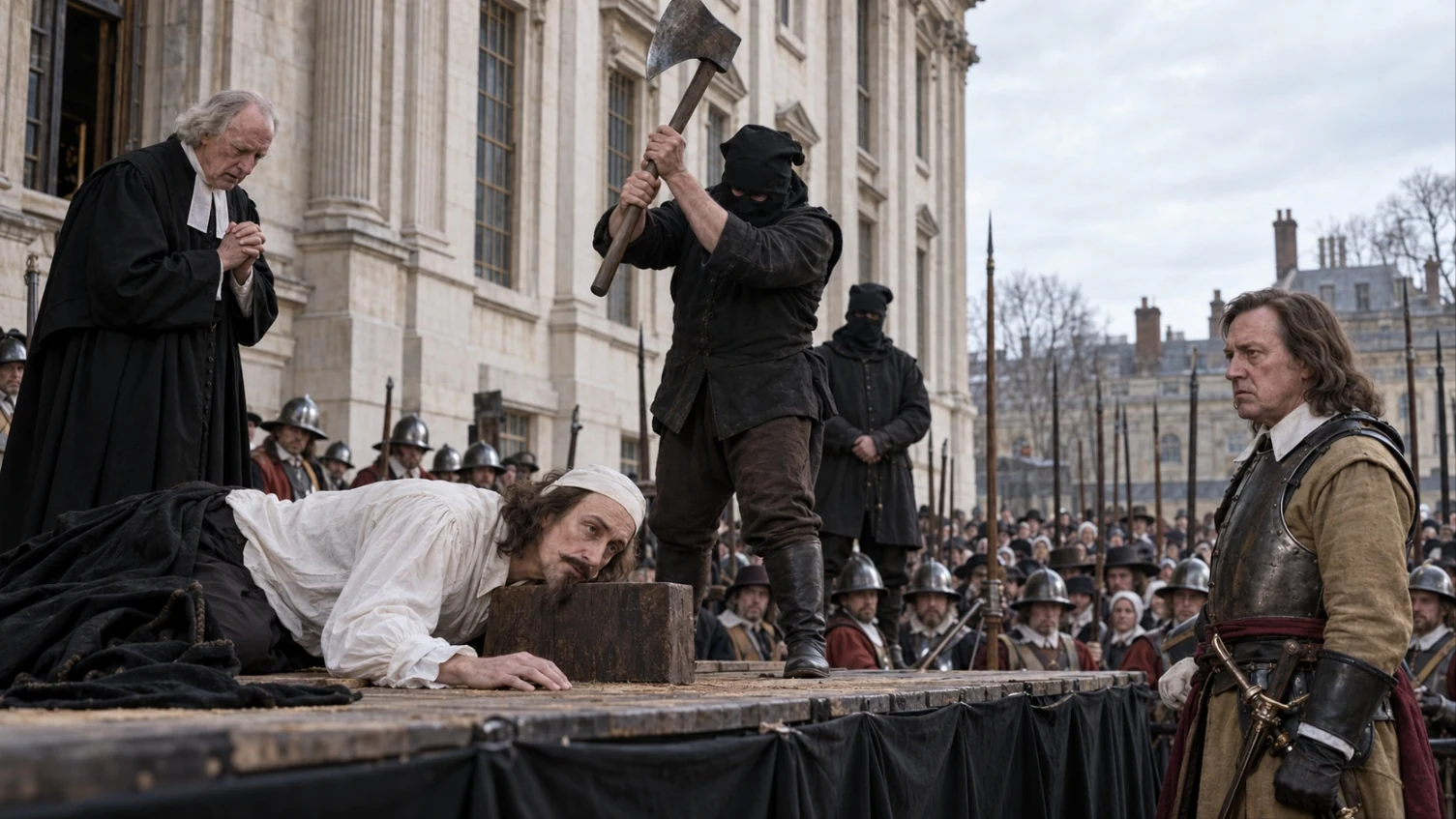 The execution of Charles I in 1649, whose death warrant Cromwell signed. (AI illustration)
Korea — Yeon Gaesomun. Like Iruka, he inherited an aristocratic family’s power. Like Nader, he replaced a king. Like Cromwell, he is judged somewhere between hero and tyrant. What sets him apart is that he killed a king with his own hands and still never became king, and that during his years in power the foreign enemy invaded repeatedly but did not conquer the country.
9. Back before the walls of Ansi
The film shows the two men reconciling as Yeon Gaesomun’s relief army arrives and the Tang army withdraws. No such scene appears in the surviving accounts consulted for this article.
What remains is one sentence the enemy emperor had heard: that Yeon Gaesomun attacked this fortress, failed to take it, and left it to its commander. And in 645, that same fortress stood in the way of Tang Taizong’s great army.
Ansi, the fortress that held off Tang Taizong, was also, according to what the Tang emperor said he had heard, a fortress that Yeon Gaesomun had failed to take a few years earlier.
Yeon Gaesomun was a ruler who killed his king, and also the man who held power through every Tang invasion of his lifetime, none of which conquered Goguryeo. Keep only one side and he cannot be explained.
Where to watch: The Great Battle has an official page on Amazon Prime Video. Netflix also has an official title page, but the film is not offered in every country. Availability on both depends on country, region, and date (checked October 2026).
This article was researched and written by K-Drama History. Source: The Great Battle, Explained: Was Yeon Gaesomun a Villain or a Defender of Goguryeo? — K-Drama History