The Scandal, Explained: Why a Joseon Household Took In a Concubine for an Heir — and Why Her Son Might Never Become One
From the research behind Pause the Drama.
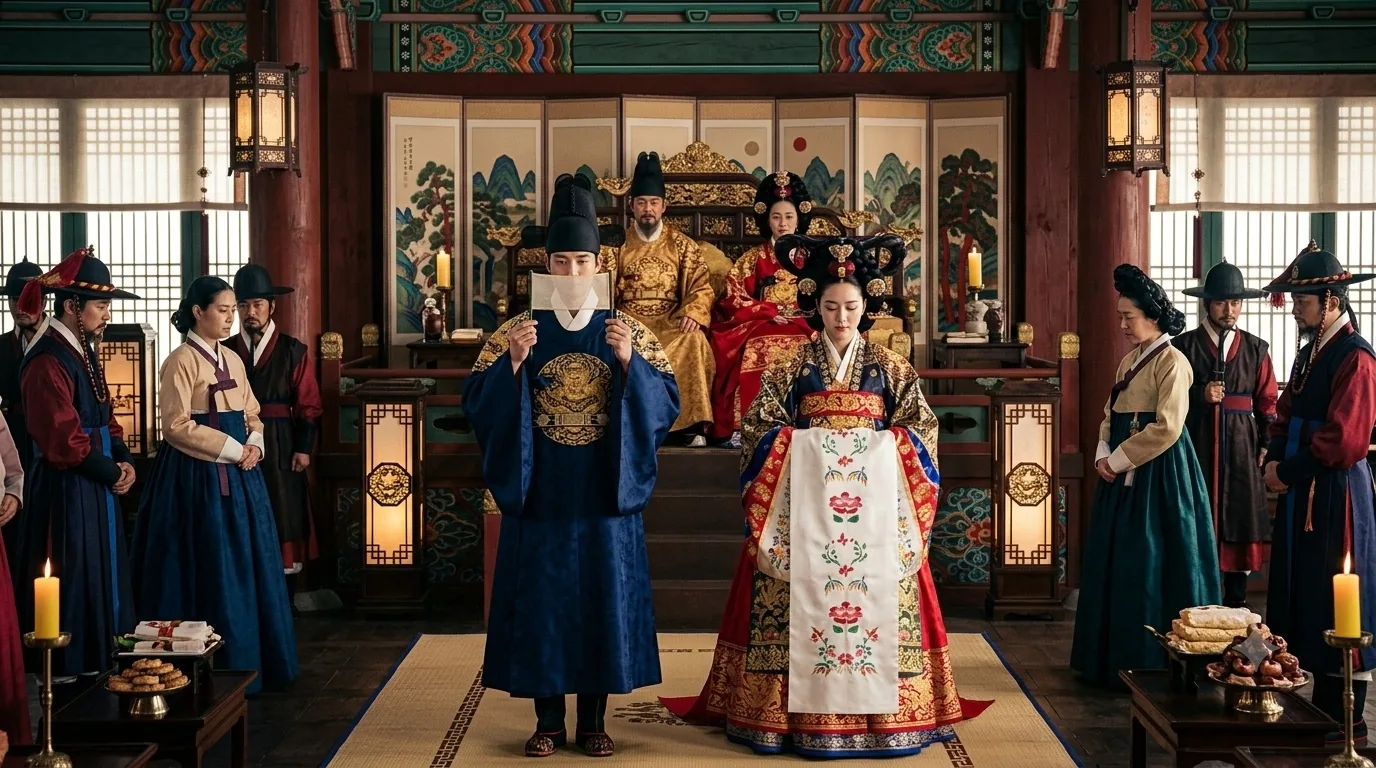
Netflix’s official synopsis for episode 1 of The Scandal (스캔들) reads: “Lady Cho masks her unease when Lord Yoo takes a young concubine for an heir. Later, she writes to her cousin Cho Won with an idea.” (Netflix official title page). The Netflix Korea official clip description and a Hankook Ilbo interview published September 30, 2026, fill in the rest: the concubine is So-ok, and Lady Cho asks Cho Won to seduce her and get her pregnant — a request that becomes the starting point for the wager that drives the whole drama (which episode the request scene falls in has not been confirmed). Lord Yoo is presented as the Minister of Rites (a detail not confirmed from the show itself for this article).
A note on what this article can and cannot say about the drama: the scene details here come only from Netflix’s official synopses and press coverage. The show has not been checked scene by scene for this article. Sources even differ on who decides to bring the concubine in — Netflix’s episode 1 synopsis has Lord Yoo taking her in, while the Netflix Korea clip description speaks of “Lady Cho, who has decided to bring in a concubine.”
Two things in this setup can be unfamiliar to viewers outside Korea. A husband openly takes a concubine because he has no son, and that concubine’s pregnancy becomes a question of the family’s fate for the principal wife.
That raises the obvious questions. Was keeping a concubine legal in Joseon? And if a concubine bore a son, did that child really carry on the family line?
First, a word about “heir,” because the title uses it loosely. “Heir” can mean several different things here: a biological son, the ritual successor who carried on the ancestral rites (bongsa) and the main line of descent, or a legally adopted successor. Receiving a share of the family’s property was a separate matter again. Joseon did not treat these categories as identical, and a concubine’s son could stand differently in each.
Quick answer: Keeping a concubine was not illegal in Joseon. But the law sharply separated the wife (cheo) from the concubine (cheop). A concubine’s son was called seoeol. The early Joseon law code barred seoeol from the civil-service examination, and even after that path opened in the 17th century, the elite “pure” posts stayed closed to them for a long time. The code let a concubine’s son carry on the ancestral rites when there was no legitimate son. But the same article also opened a path to adopting an heir from within the patriline, and in late Joseon, upper-class scholar-official households showed a strong preference for that path. Property was a separate question: concubines’ children did receive shares, only smaller ones. These rules also did not stay fixed — how they operated, and which routes of advancement were open to concubines’ sons, changed over the dynasty.
Keeping a concubine was not illegal in Joseon. But the legal discrimination between wife and concubine was unmistakable — and it carried over to the children a concubine bore.
When did The Scandal premiere, and what is it based on?
The Scandal premiered on Netflix on September 18, 2026, with all eight episodes released at once (rated TV-MA). It is directed by Jung Ji-woo and stars Son Ye-jin as Lady Cho, Ji Chang-wook as Cho Won, Nana as Hui-yeon, and Shin Yun-ha as So-ok. It adapts Choderlos de Laclos’s epistolary novel Les Liaisons dangereuses (1782). According to the Hankook Ilbo (September 30, 2026), it is the fourth Korean screen adaptation, after the film Untold Scandal (2003), the film Dangerous Liaisons (2012), and the drama The Great Seducer (2018). Press interviews place the story in Bukchon, Hanyang, in King Jeongjo’s era. The series is available on Netflix worldwide (official title page), though availability, subtitles, and dubbing may vary by country and region.
The drama’s main storyline is the wager between Cho Won and Hui-yeon; the concubine plot is a side thread. This article covers only that thread.
How was a wife different from a concubine?
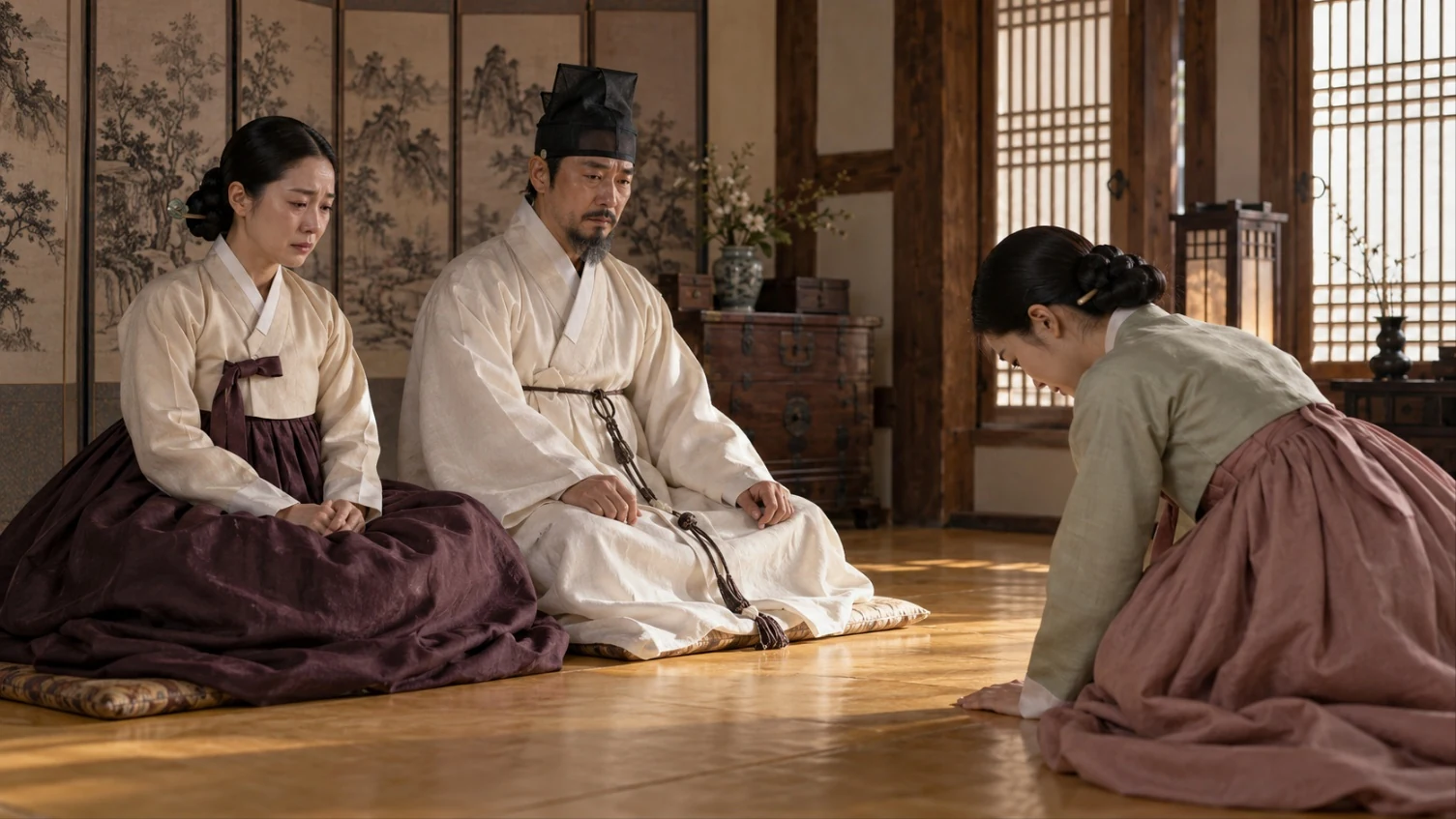 A concubine entering the household bowed before both husband and wife. The law kept the distance between the two women. (AI illustration)
In the drama, So-ok is called a sosil. Sosil, cheuksil, and cheop all refer to the same position. Lady Cho is the principal wife, married in a formal wedding; So-ok is someone brought in beneath her. In Joseon, the difference between them was a matter of law, not feeling.
In early Joseon, who counted as the “real wife” was a matter for lawsuits. Until the end of Goryeo, there was a practice of keeping more than one wife. As a result, lawsuits over whose children were legitimate — among several wives, or between wives and concubines — were frequent (Woori History Net, “Seoeol,” nh_025_0020_0040_0040). In 1414 (Taejong 14), Inspector-General Yu Gwan and others set a standard for judging disputes in which the children of an earlier wife and a later wife each claimed to be the legitimate heirs (Taejong Sillok, Taejong 14, 6th month, 20th day). Research holds that disputes over distinguishing wives from concubines were largely settled only around the 16th century (Lee Sook-in 2024, based on the abstract).
One wife; concubines outside that. Joseon’s principle was to recognize only one wife. A concubine was a woman kept outside that bond. Concubines were further divided by birth:
| Category | Mother’s origin | Children called |
|---|---|---|
| Yangcheop (良妾) | Commoner (yangin) | seoja (sons), seonyeo (daughters) |
| Cheoncheop (賤妾) | Lowborn — slaves, gisaeng, etc. | eolja (sons), eollyeo (daughters) |
Seoja and eolja together are called seoeol (Lee Sook-in 2024). In principle, a lowborn concubine’s children could inherit their mother’s lowborn status, though there were some exceptions for children of officials by lowborn concubines (Encyclopedia of Korean Culture, “Nobi,” E0012757). Hereditary slave status is covered in this site’s article on Chuno, so this article goes no further.
Even when her son carried on the line, a concubine was not enshrined in the family shrine. If a concubine’s son came to carry on the family’s ancestral rites, the rites for his birth mother were held not in the family shrine but in a private room (sasil), and they ended with that son’s generation (Gyeongguk Daejeon, Rites Code, Article on Ancestral Rites, as cited in Woori History Net km_024_0060_0020_0020_0030). Her son could become head of the family, but she herself never became one of its ancestors.
Could a concubine’s son carry on the family line?
Lord Yoo takes So-ok in to get an heir. So if So-ok had a son, would that solve the problem? Here “heir” means the ritual heir — the son who carried on the ancestral rites and the main line — not simply a son who received property. On that question, Joseon’s law code answered yes. But the practice of upper-class yangban society often leaned toward no.
One caution before the details. The legal distinction between wife and concubine had a long history, but its practical operation and the routes of advancement open to concubines’ sons changed over the dynasty. The 15th-century code quoted below is a starting point, not a snapshot of the late-18th-century Seoul in which the drama is set.
The code: a concubine’s son could carry on the rites. The Gyeongguk Daejeon’s article on ancestral rites set out an order. If the eldest legitimate son had no heir, another legitimate son (jungja) carried on the rites; if there was no other legitimate son either, a concubine’s son (cheopja) did. Among concubines’ sons, a commoner concubine’s son came before a lowborn concubine’s son (Encyclopedia of Korean Culture, “Cheopja Bongsa,” E0056215; Woori History Net km_024). The encyclopedia traces this principle back to Goryeo’s heir-designation law (ipsabeop) of 1046 (Jeongjong 12) (E0056215). Scholars read the scope of jungja in this article differently, so it is given here simply as “another legitimate son.”
The small print in the same article. The article carried an interlinear note: if a family’s eldest legitimate son had only concubines’ sons and wished to make his younger brother’s son his heir, this was permitted. A Myeongjong Sillok entry for Myeongjong 8, 9th month, 11th day (kma_10809011_002) quotes the note in officials’ reports, and km_024 records the same. The author of the Woori History Net chapter explains the note as the law acknowledging a reality in which discrimination between legitimate and concubine-born sons was thoroughgoing. In effect, the code built two exits from the start.
Practice: adoption within the patriline. From the 16th century, as Neo-Confucian learning and ritual studies deepened, a preference emerged for establishing an heir by adoption (iphu, 立後). In 1580 (Seonjo 13), the court ruled that an adopted heir took precedence in succession over a biological son born later, and this principle became formal law in the Sokdaejeon. Late Joseon yangban households took adoption for granted, and abuses arose, including taking another family’s only son (km_024). In this trend, concubines’ sons were often pushed out of the competition to become ritual heir. Among the three grievances that 18th-century seoeol raised in collective petitions, one was gyehu (繼後) — being excluded from becoming an heir (Woori History Net, New History of Korea, “The 18th-Century Seoeol Tongcheong Movement,” nh_034_0020_0020_0020_0010).
That said, this preference should be read within its range. The km_024 chapter describes a strong preference for adoption among late Joseon yangban households, while the Encyclopedia of Korean Culture’s entry on concubines’ sons carrying on rites (E0056215) notes that among lower-ranking yangban and ordinary commoners, cases of concubines’ sons serving directly as ritual heirs were not few. Neither source amounts to a statistic by social class. What can be said is that among upper-tier scholar-official families — the world of a minister like Lord Yoo — adoption was strongly preferred.
A son born to a concubine taken in for an heir was not guaranteed to become the ritual heir.
Office: first the exam hall door, later the elite-post door. After the law barring seoeol (seoeol geumgobeop) was created under King Taejong, the Gyeongguk Daejeon barred seoeol not only from the civil-service examination (mungwa) but also from the classics and literary licentiate exams (saengwonsi and jinsasi). Technical posts were open to them, but there were caps on the rank they could reach, depending on the father’s rank and the mother’s status (Woori History Net textbook glossary, “Seoeol,” tg_003_0330). For example, descendants of officials of the second rank or higher by commoner concubines were capped at senior third rank (lower grade), and those by lowborn concubines at senior fifth rank (Woori History Net nh_025_0020_0040_0040). This was called hanpum seoyong (限品敍用), “appointment within limited rank.”
This bar did not stay fixed throughout Joseon, and it should not be read as an absolute rule that held unchanged for five centuries. Under the 1625 (Injo 3) heotong samok regulations, a commoner concubine’s line could be cleared from the grandson’s generation and a lowborn concubine’s line from the great-grandson’s generation (Woori History Net nh_039 gives the lowborn concubine’s line as “from the grandson’s generation,” so the sources differ), while the generations in between could be cleared by paying grain (napsok). In 1696 (Sukjong 22), this grain condition was abolished, and seoeol were able to sit the civil and military examinations (Encyclopedia of Korean Culture, “Heotong,” E0063169; Woori History Net nh_039_0040_0040_0020).
Even after the exams opened, the results were meager. According to the Encyclopedia of Korean Culture, over the 138 years from 1597 to 1735, only 42 seoeol passed the civil-service examination (E0027919). Even after passing, it was hard for them to reach the cheongyojik, the core “pure and important” posts in charge of scholarship and remonstrance. So the seoeol struggle shifted from permission to sit the exams (heotong) to access to the elite posts (tongcheong) (Lee Ji-young 2013, abstract; nh_039_0040_0040_0020).
Property: they did inherit — but a small share. Property inheritance is a different question from ritual succession. The common claim that “a concubine’s children didn’t get a single coin” is wrong. The Gyeongguk Daejeon’s penal code provision on dividing private slaves states that children of a commoner concubine receive “one-seventh” (七分之一) and descendants of a lowborn concubine “one-tenth” (十分之一) (the Gyeongguk Daejeon text as quoted in the Gyeongguk Daejeon Juhae, Penal Code, Article on Private Slaves, Korean History Database jlawb_030_0010_0050_0040_0030). This quoted provision, however, governs the slaves of a legal mother who had no children of her own. This article does not generalize that ratio to all parental slaves or property, nor convert it into a fraction of a legitimate child’s share.
How did principal wives treat concubines — and did a concubine ever become a wife?
According to the synopsis, Lady Cho hides her anxiety before her husband’s concubine and lays a scheme. How did real Joseon principal wives treat their husbands’ concubines and those concubines’ children? Two cases show different sides: a wife who cared for a concubine’s children, and a concubine who displaced a wife.
Yu Hui-chun and Song Deok-bong — a household that looked after even a concubine’s daughters. Song Deok-bong was a writer who left a collection of poetry and prose, the Deokbong-jip, and the wife of the 16th-century official Yu Hui-chun (Woori History Net, “Yu Hui-chun,” kc_n308010). Yu Hui-chun’s diary, the Miam Ilgi, preserves poems in which Song Deok-bong gently admonishes her husband, as well as accounts of efforts to marry the daughters his concubine bore into good families (Korea Heritage Service, Monthly Gukgayusan Sarang, January 31, 2023, by Shin Gwan-ho). The article does not say who took charge of those marriages. Separately, Lee Seong-im’s research shows Song Deok-bong bringing her husband’s concubine and the concubine’s children into the family order and caring for them (Lee Seong-im 2013). Caring for them and arranging the daughters’ marriages are not, however, the same act on this evidence. What the record does show is a writer-wife, her husband’s concubine, and the concubine’s daughters bound up together in one household. That a concubine’s daughter’s marriage required this much effort is this article’s interpretation.
Jeong Nan-jeong — a rare case of a concubine rising to principal wife. Jeong Nan-jeong was the daughter of the official Jeong Yun-gyeom by a government slave. Woori History Net (kc_n308200) calls her a seonyeo, but since her mother was lowborn, by the categories above she would be an eollyeo. After becoming the concubine of Yun Won-hyeong, the most powerful minister of King Myeongjong’s reign, she drove out his principal wife, Lady Kim, in 1551 (Myeongjong 6), took the position of legal wife, and even received the title Jeonggyeong buin (Encyclopedia of Korean Culture, “Jeong Nan-jeong,” E0050041). Raising a concubine to wife had been named as a taboo as far back as the ancient Chinese covenant at Kuiqiu (Mencius, Gaozi II, as cited in Woori History Net km_024_0060_0020_0020_0030; the classical text itself has not been checked).
The end, however, was collapse. In 1565, Queen Dowager Munjeong died and Yun Won-hyeong was impeached. That year, the Myeongjong Sillok records a request to revoke Jeong Nan-jeong’s certificate of rank as a noble wife (buincheop); Myeongjong at first refused, then approved it after a long delay (Myeongjong Sillok, Myeongjong 20, 8th month, 27th day, kma_12008027_005). The approval came while she was still alive, though since the entry’s closing portion appends later developments, the 27th day of the 8th month should not be taken as the date the revocation was carried out. Revoking that certificate concerned her title and her standing as wife versus concubine; it cannot by itself be equated with the “return to original status” that the encyclopedia describes. The Encyclopedia of Korean Culture states that she was returned to her original status after her death (E0050041), but a separate primary source for that has not been confirmed.
Then a complaint from Lady Kang, wife of the late magistrate Kim An-su, brought Lady Kim’s death into question (Myeongjong Sillok, Myeongjong 20, 9th month, 8th day, kma_12009008_001). Jeong Nan-jeong died first, and Yun Won-hyeong, having seen her death, died after her in grief and indignation (Myeongjong Sillok, Myeongjong 20, 11th month, 18th day, obituary of Yun Won-hyeong, kma_12011018_005). The Encyclopedia of Korean Culture (E0050041) says the two took poison together, which differs from the Sillok; this article follows the Sillok.
Accounts of Lady Kim’s death differ in strength. The Encyclopedia of Korean Culture (E0050041) and Woori History Net’s “Yun Won-hyeong” (kc_n308200) state that Jeong Nan-jeong poisoned Lady Kim. The Myeongjong Sillok record has several layers that need to be kept apart. On the 8th day of the 9th month, Lady Kang’s complaint lays out a specific accusation of poisoning (kma_12009008_001), and in a separate entry the same day, remonstrance officials who had reported that Lady Kim starved to death asked to be dismissed, saying they had misheard the facts (wma_12009008_002). On the 22nd day of the 10th month, the chief interrogator Yi Myeong requested arrests based on maidservants’ confessions, and the king ordered the interrogation halted (wma_12010022_001). The court historian’s commentary narrates the poisoning as fact. Because the accusation, the interrogator’s judgment, the king’s decision, and the historian’s assessment are different things, this article writes “the poisoning allegation” rather than “she poisoned her.”
A concubine could become a wife. But Joseon took it back.
Where does the drama part from history?
The Scandal is a fictional drama that moves Les Liaisons dangereuses to Joseon. Its characters and events are invented. What follows covers only the differences that bear directly on the subject of concubines.
Difference 1 — taking a concubine for an heir. Taking a concubine because there is no heir is plausible in itself. But in King Jeongjo’s era (the late 18th century), when the drama is set, a high-ranking yangban household like that of a Minister of Rites would plausibly have turned to adopting an heir from within the patriline rather than relying on a concubine’s son (see above; km_024). What the premise leaves out is that a concubine bearing a son would not by itself have settled who carried on the family’s rites.
Difference 2 — So-ok’s status. In the categories of early Joseon law, whether a concubine was a commoner or lowborn shaped her child’s status and the rank caps on his career — seoja or eolja. How the drama sets So-ok’s status has not been confirmed from the show itself.
The irony of a Jeongjo setting. King Jeongjo appears in the drama (according to a Korea Daily review of September 21, 2026; the scenes have not been checked for this article). After 1696, seoeol could already sit the examinations. What remained in Jeongjo’s time was the wall between passing and reaching the elite posts. In 1772, King Yeongjo issued a royal message declaring that seoeol would be used in elite posts as well (Encyclopedia of Korean Culture, “Seoeol Geumgobeop,” E0027919). In 1777 (Jeongjo 1), Jeongjo issued the Jeongyu regulations (Jeongjo Sillok, Jeongjo 1, 3rd month, 21st day, kva_10103021_001), and in 1779 (Jeongjo 3) he selected four scholars of concubine birth — Yi Deok-mu, Yu Deuk-gong, Bak Je-ga, and Seo I-su — as the first archive clerks (geomseogwan) of the Kyujanggak (Woori History Net, “Bak Je-ga,” kc_n304300; “Geomseogwan,” tg_003_2280). They are known as the “Four Clerks” (sageomseo).
Assessments of the Jeongyu regulations are divided. Woori History Net’s “Bak Je-ga” entry presents the clerk appointments as putting the 1777 seoeol regulations into practice (kc_n304300). The New History of Korea, by contrast, holds that the Jeongyu regulations effectively stepped back from late Yeongjo’s position, merely reaffirming the principle from King Injo’s reign of allowing important posts but barring the “pure” posts (nh_034_0020_0020_0020_0010). The regulations opened, on a graded basis, posts such as middle-rank offices in the Boards of Taxation, Punishments, and Works and the post of lecturer (jikgang) at the Sungkyunkwan, and among local posts, governors such as moksa and busa (nh_039_0040_0040_0020). They also distinguished candidates by the standing of their father’s main lineage and included provisions for exceptional appointment of outstanding individuals (kva_10103021_001). The archive clerk posts themselves were working posts at seventh rank or below (kc_n304300). This article does not merge the two assessments. Jeongjo was a king who kept seoeol intellectuals close; he was not the king who tore down the wall of seoeol discrimination.
Had So-ok borne a son, the path to the examinations would have been open to him — but strong barriers to the core posts would likely have remained.
How did concubines and their sons fare elsewhere?
The three cases below are not equivalents of Joseon. Chinese concubinage, the Ottoman court’s slave-based harem, and Meiji Japan’s family law were different legal structures, and translating all of them as “concubine” hides real differences. They are here as contrasts: each society handled children born outside the principal marriage, and the question of succession, in its own way.
Song China — a similar hierarchy, different treatment of sons. In Song China (960–1279), too, there was one wife, and a concubine was not a wife. A wife was taken with betrothal gifts and a wedding; a concubine was bought, much like a maidservant. Yet a concubine’s son had the same property-inheritance rights as the wife’s son — in return, he had to honor his father’s wife as his legal mother (Ebrey 1986, abstract; this is not generalized to every era of China). The Tang code is cited as allowing a concubine’s son to be made heir if the wife passed fifty without a son (as cited in Woori History Net km_024). The wife-concubine hierarchy resembled Joseon’s in outline; the contrast is that, on Ebrey’s account, a concubine’s son had the same rights to the family property as the wife’s son.
The Ottoman Empire — a concubine’s son as master of the empire (a different system altogether). In the 16th-century Ottoman dynasty, sultans produced heirs by concubines of slave origin, and formally marrying a concubine was regarded as unprecedented (review of Peirce 2017, Cambridge journal). Hürrem (Roxelana), concubine of Süleyman I, entered the harem as a slave, was legally married to the sultan, and was freed from slavery; her son took the throne as Selim II (Britannica, “Roxelana”). This was a dynastic court built on slave concubinage, not a household law like Joseon’s, so the point is the contrast: Joseon’s Jeong Nan-jeong went from concubine to wife and was stripped of it; Hürrem’s son inherited the throne.
Meiji Japan — a concubine written into law at the start of modernization. The Meiji government’s first criminal code, the Shinritsu Kōryō (新律綱領), issued in Meiji 3 (late 1870; possibly early 1871 by the Gregorian calendar), was modeled on the Ming and Qing codes and used until the old Penal Code took effect in 1882 (Nihon Kokugo Daijiten, “Shinritsu Kōryō,” kotobank). One study holds that this code classed a concubine as a relative of the second degree, the same as a wife (Tokoro Yumi 2011; the full text of the study and the code itself have not been checked). If so, it is a paradoxical case: at the very threshold of modernization, the concubine found a place inside the law.
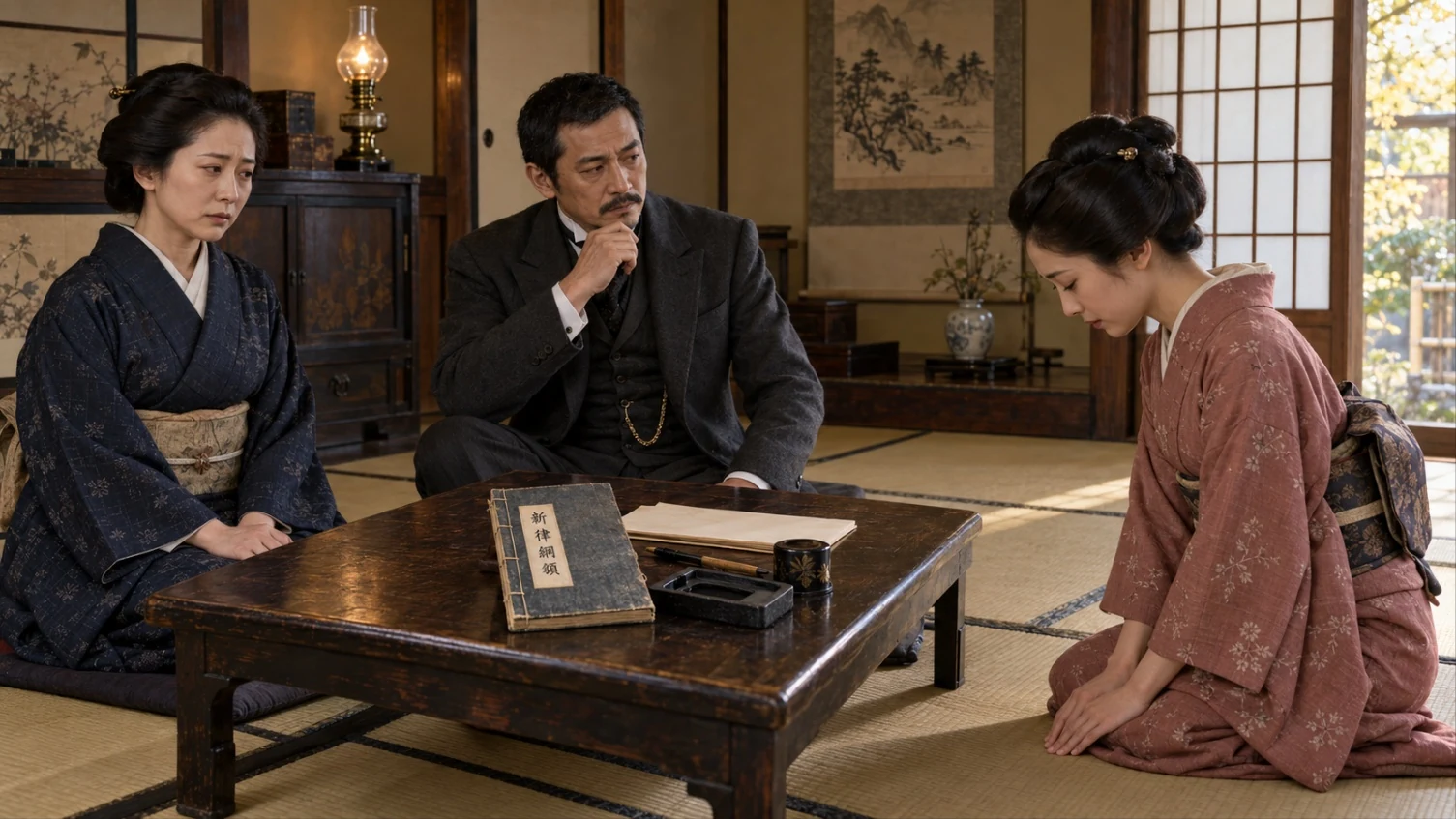 Meiji Japan’s first criminal code, the Shinritsu Kōryō, is reported to have listed a concubine among a man’s relatives. (AI illustration)
And Joseon. Joseon did not forbid concubines, and its wife-concubine hierarchy resembled Song China’s in outline. But by the measures checked here it treated concubines’ sons more strictly. It long barred them from the civil-service exam, and after that path opened it still kept them from the elite posts; in the property provision checked here, it gave them smaller, graded shares of slaves; and among upper-class households, even the place in ritual succession that the code had left them often went to an heir adopted from within the patriline. Set beside these contrasts, what stands out in Joseon is how it treated not only the concubine but also her child.
Back to The Scandal
What Lady Cho’s scheme targets is less So-ok the person than the child So-ok might have. As the official synopsis frames it, that single child seems to hold the principal wife’s place and the family’s future.
Real Joseon moved somewhat more coldly. A concubine could live in the house. But her son could not enshrine his birth mother in the family shrine; for a long time he could not enter the civil-service exam hall, and even after he could, the elite posts remained hard to reach; and in upper-class households, his place as ritual heir could go to an heir adopted from within the patriline. Jeongjo called seoeol scholars to his side — but the clerk posts were working posts at seventh rank or below, and his wider regulations still kept the “pure” posts out of reach.
The law left a concubine’s son a place in the ritual succession. But among upper-class households, that place often went to an heir adopted from within the patriline.
This article was researched and written by K-Drama History. Source: The Scandal, Explained: Why a Joseon Household Took In a Concubine for an Heir — and Why Her Son Might Never Become One — K-Drama History