Warrior K (무신), Explained: Why Did Goryeo Move Its Capital to an Island — and Who Made the Decision?
From the research behind Pause the Drama.
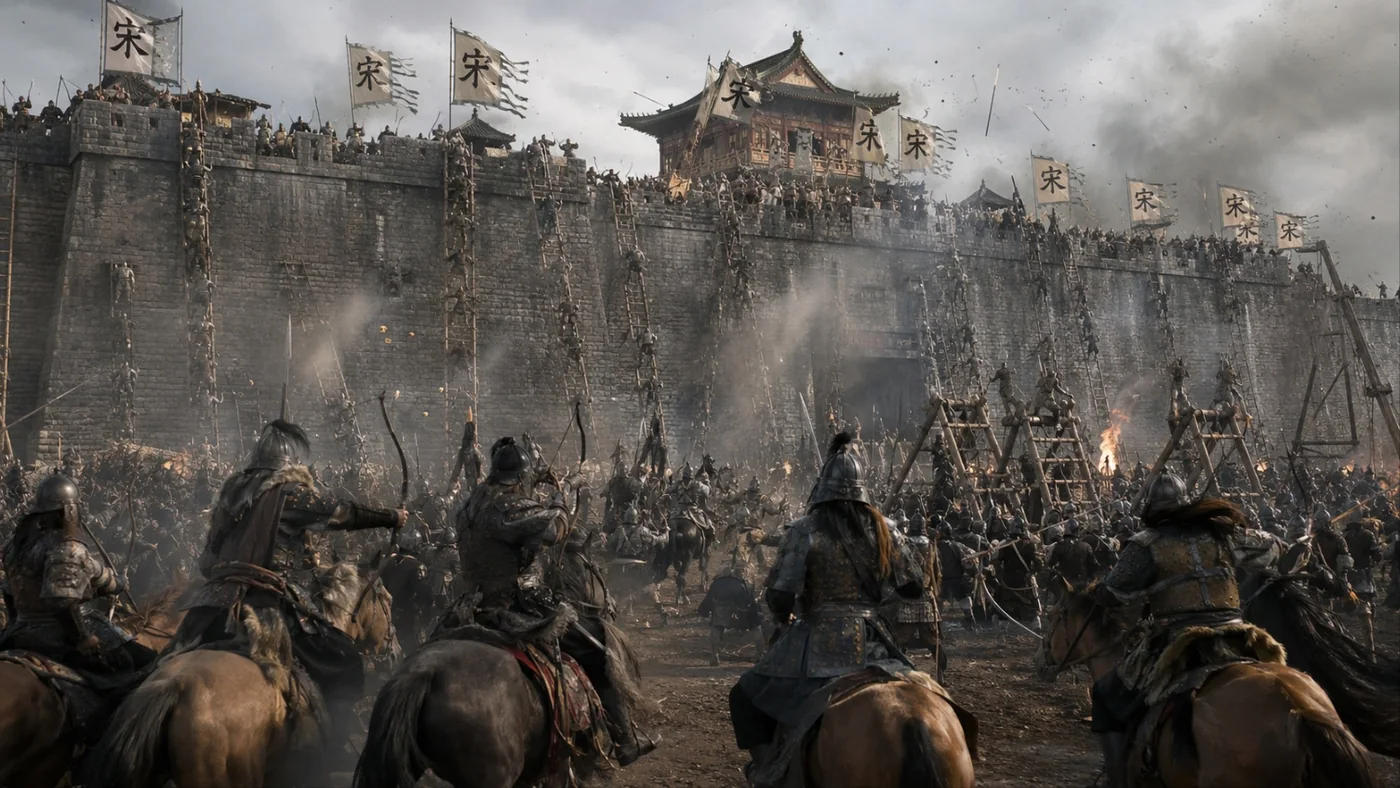
According to MBC’s official episode summaries, Choe U, the military strongman of Goryeo, announces the move of the capital to Ganghwa Island before King Gojong and his officials in episode 26 of Warrior K (무신, 2012). In episode 27, Gojong follows Choe U’s view that the move must be hurried and leaves Gaegyeong (Kaesong) with his officials. MBC’s character profile presents Choe U as a leading figure of thirty years of resistance against the Mongols and as the real driving force behind the carving of the Tripitaka Koreana.
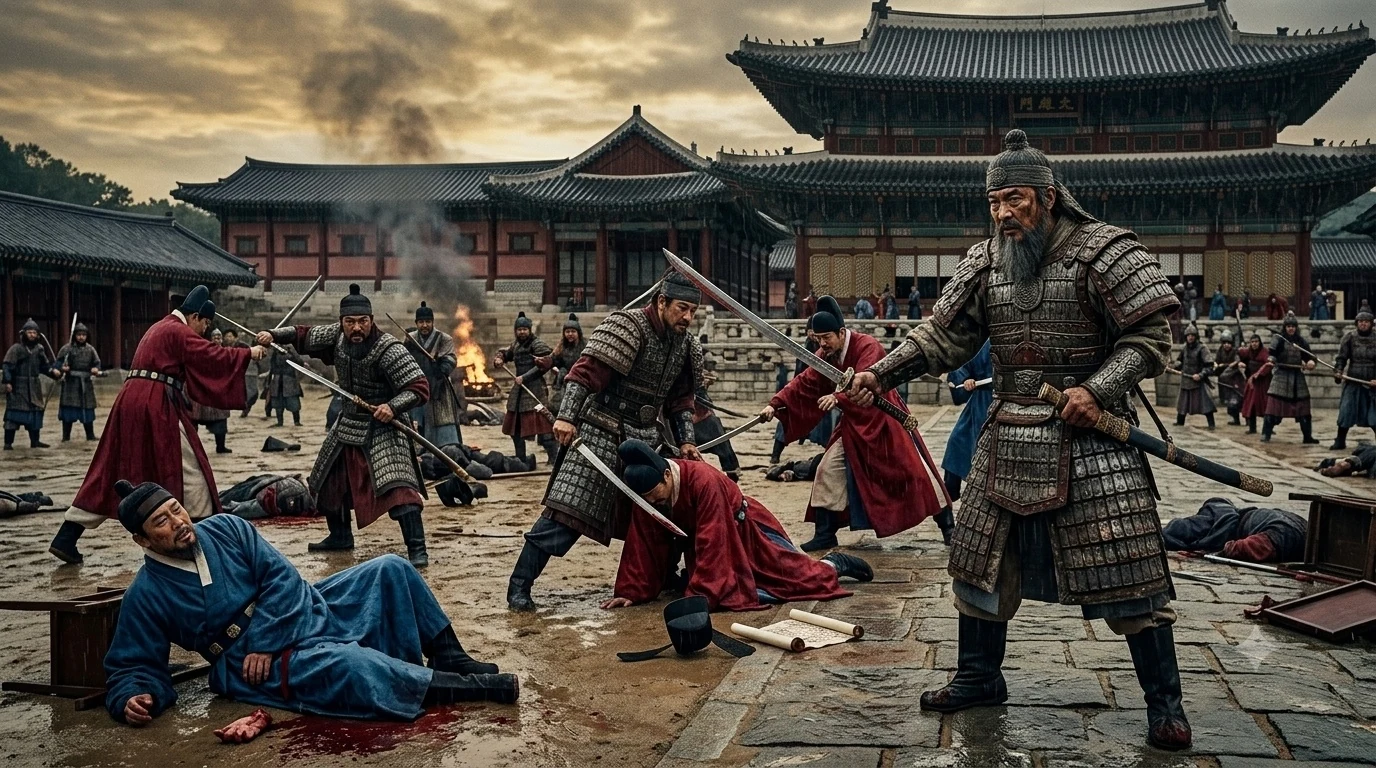
The scene in the historical sources is much darker. The decisive council recorded in the Goryeosa jeoryo was convened at Choe U’s own house, not in the palace. The chronicle records that the king hesitated. An officer who argued for defending Gaegyeong was dragged out and beheaded. So why did Goryeo move its capital across the water to an island, and who made that decision?
A note on the drama scenes: we confirmed the episode 27 summary against MBC’s official page. For episodes 25 and 26, we rely on research notes that quote MBC’s official summaries; this article’s author could not open those summaries or watch the episodes. Most of what this article focuses on is not mentioned in the summaries we know of: Yu Seung-dan’s and Kim Se-chung’s opposition, the uprising in Gaegyeong, the suffering of people on the mainland, and the terrain. We don’t know whether any of it appears on screen, so we haven’t treated it as drama scenes.
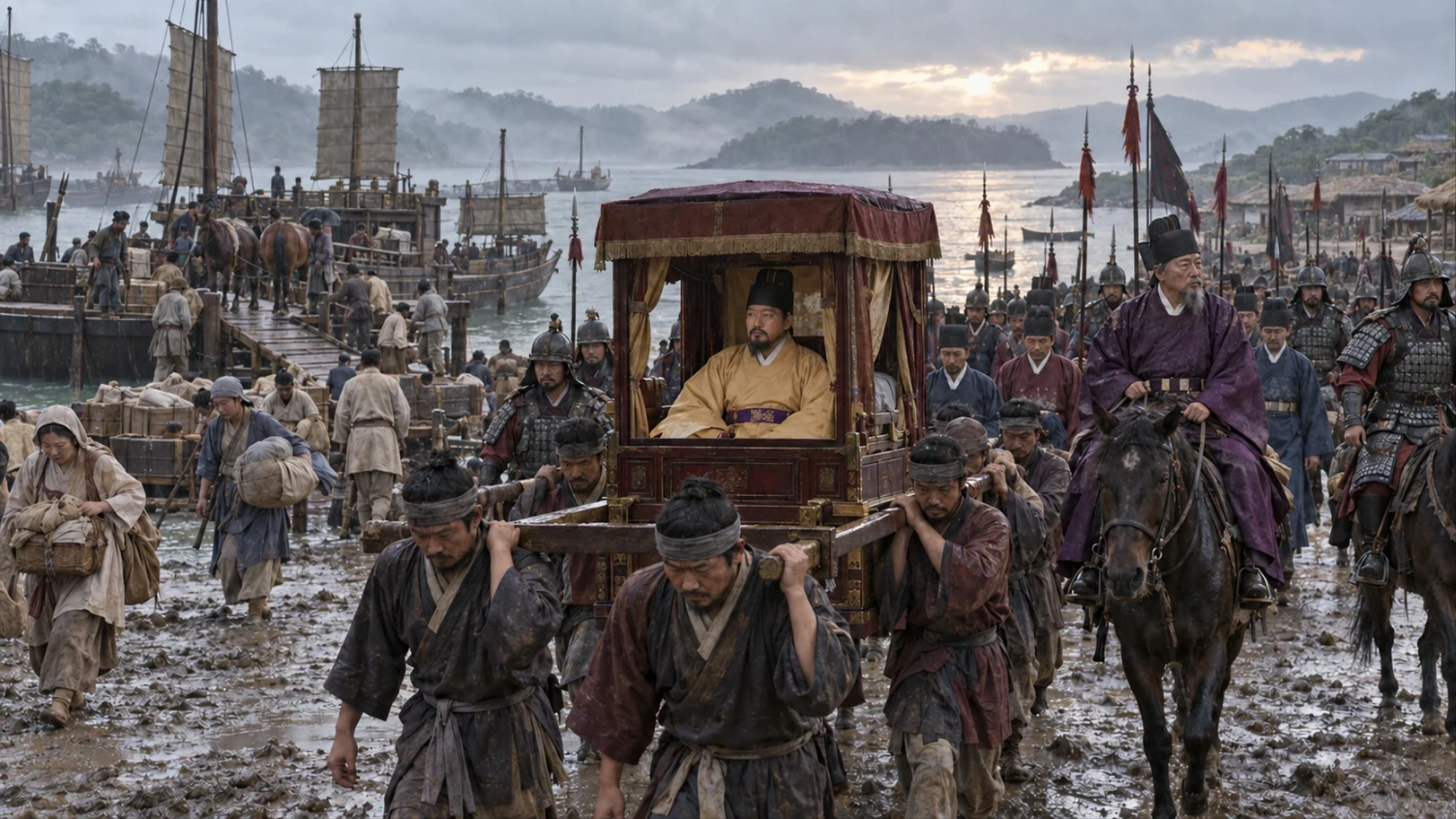 The court leaves Gaegyeong for Ganghwa in 1232. No record describes the procession in this detail — this is an illustration, not a reconstruction. (AI illustration)
Quick answer: Goryeo moved its capital from Gaegyeong to Ganghwa Island in 1232 under pressure from the military ruler Choe U. The Goryeosa says Choe U threatened King Gojong into the move, while the Goryeosa jeoryo records that the decisive council was convened at Choe U’s own house despite open opposition, and that an officer who argued for defending Gaegyeong was beheaded. The court stayed on the island until the return to Gaegyeong in 1270.
Two stories, one decision
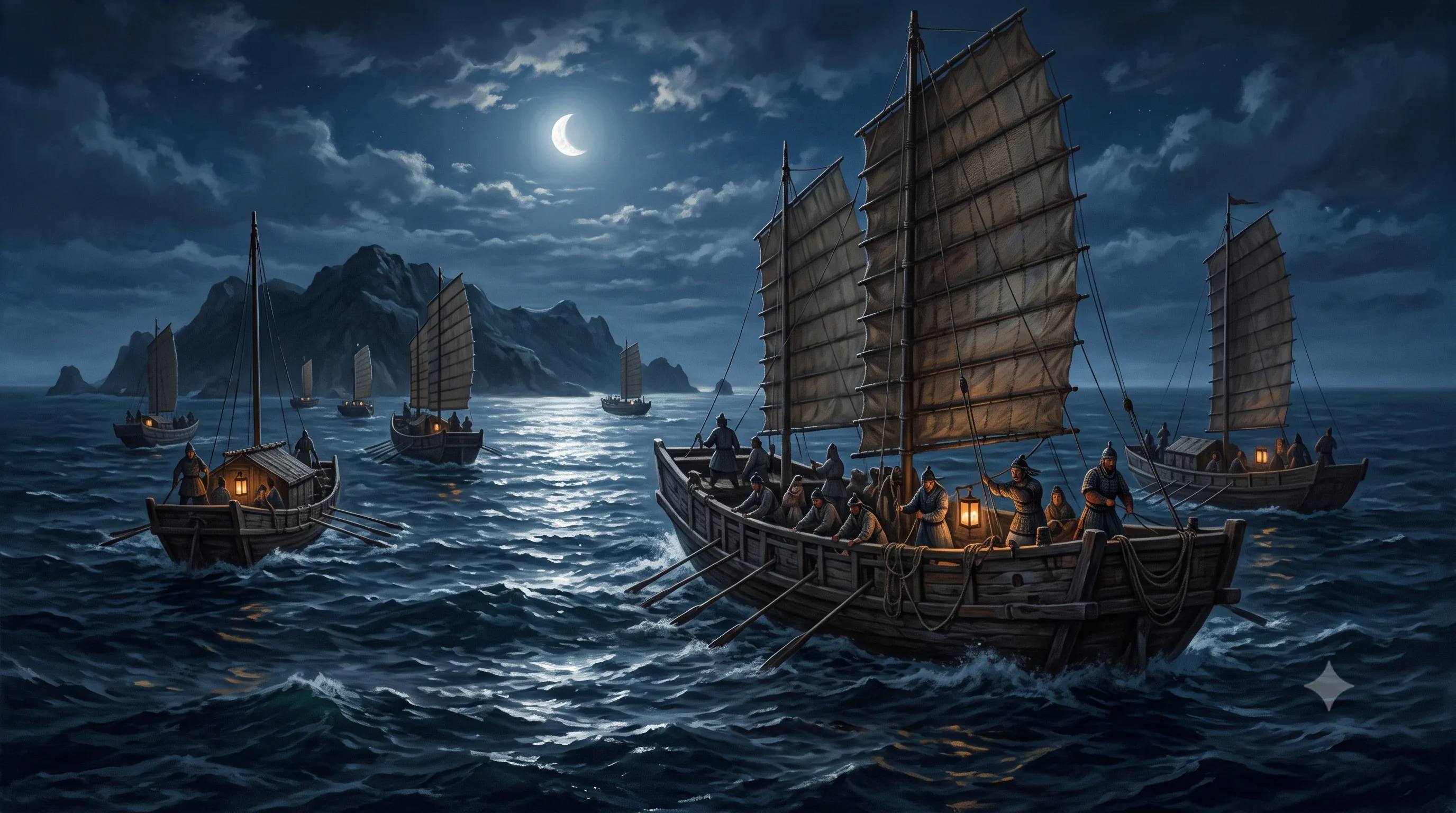
The 1232 move of the capital to Ganghwa was a strategy that used the sea as a shield against the Mongols. It was also a decision by the military ruler Choe U, pushed through over opposition. These are not two separate stories; both are part of the same decision. In the decades that followed, people on the mainland who could not get onto the island took the full force of the Mongol invasions.
The council that settled the move met not in the palace but in Choe U’s house.
The island protected the dynasty. The people on the mainland had to protect themselves.
The decision did not come overnight
After the first Mongol invasion in 1231, Goryeo made peace. But the Encyclopedia of Korean Culture explains that the Mongols then stationed darughachi (達魯花赤, overseers sent by the Mongols) in occupied areas to interfere in internal affairs, and demanded heavy tribute and hostages.
According to the records, Choe U made up his mind to move the capital around the twelfth month of 1231, while the first invasion was still going on. Officials of Seungcheon-bu, the district across the strait from Ganghwa, told him that Ganghwa Island was suitable as a refuge, and he sent people to inspect it. In the second month of the following year, 1232, the move was formally raised at a meeting of senior ministers (jaechu), but most officials opposed it and it went no further. According to a commentary by the National Institute of Korean History, the question was discussed four times in all, and each time it failed because most of the high ministers insisted on holding Gaegyeong. Those in favor were essentially Choe U’s close associates Jeong Mu and Dae Jip-seong.
There is also a record that the Mongols demanded 500 young boys and 500 young girls from the families of the royal house and high officials. The commentary treats this demand as the point at which Mongol demands could no longer be accepted.
Then, on the 15th day of the sixth month (lunar calendar), a party of envoys who had escaped from the Mongols brought a rumor that the Mongol army would invade again. The next day, Choe U held the fourth meeting at his own house. These dates follow the National Institute of Korean History commentary.
That day at Choe U’s house
The Goryeosa jeoryo (高麗史節要) is a chronological history compiled in 1452, in the early Joseon period. It reports that Choe U gathered the senior ministers and privy councillors (jaechu) at his house to discuss moving the capital. Gaegyeong was then a prosperous city, which the chronicle describes as having 100,000 households and full of luxurious mansions. People did not want to move, but they feared Choe U, and no one said a word.
Only Yu Seung-dan, a senior minister (chamji jeongsa), objected. His biography in the Goryeosa records his argument this way: “for a small country to serve a large one is what is right” (以小事大, 義也). If Goryeo served the Mongols with proper ritual and dealt with them in good faith, the Mongols would have no pretext to harm it.
That night, Kim Se-chung, an officer (jiyu, 指諭) of the Byeolcho, pushed his way in through the door and objected to the move. Gaegyeong, he said, had been held for more than 200 years since the dynasty’s founder, Taejo. Its walls were strong, and it had plenty of soldiers and grain, so Goryeo should join forces and defend it. When Choe U asked him how the city should be defended, Kim Se-chung could not answer. The Grand Censor Dae Jip-seong then asked that he be beheaded and his execution displayed to the realm, because, in the chronicle’s words, he was following “the talk of women” and daring to obstruct a great deliberation. Kim Hyeon-bo (金鉉寶), a senior general (sanghogun) of the Eungyang Guard (鷹揚軍), fell in with Dae Jip-seong and said the same. Kim Se-chung was then dragged out and beheaded. The chronicle does not say in so many words who gave the order; it records only the request, the agreement, and the execution, all at a council held in Choe U’s house.
The day of the decision and after: what happened to the king and the people
That same day, Choe U asked the king to come down from his throne hall at once and travel west to Ganghwa Island. According to the chronicle, the king “hesitated and could not decide” (王猶豫未決). Choe U seized more than a hundred carts used to carry officials’ salaries (奪祿轉車百餘兩) and sent his own household’s goods to Ganghwa first. The capital was thrown into unease.
Officials were told to send away the residents of Gaegyeong’s five wards (五部) by fixed dates, and notices were posted inside the walls: “Those who delay and do not take to the road by the deadline will be dealt with under military law” (遷延, 不及期登道者, 以軍法論). Envoys were also sent to the provinces to move people into mountain fortresses and onto islands (徙民山城海島). On Ganghwa, two ryeong of soldiers were assigned, and work on a palace began.
The Encyclopedia of Korean Culture sums it up as the result of Gojong giving in to pressure from Choe U, even though he did not want to go. The Goryeosa’s entry for that month says more: it records that Choe U threatened the king and moved the capital to Ganghwa. The encyclopedia also writes that on the day the king left with his civil and military officials, Yi Tong, a low-ranking clerk (joye) of the Censorate, raised a revolt. He gathered bandits (chojeok), slaves, and monks, saying he would defend Gaegyeong. On the day the capital was abandoned, people rose up to defend it. The encyclopedia gives the date the king left Gaegyeong as the 6th day of the seventh month. That means about three weeks passed between the decision and the king’s departure.
Why Ganghwa?
First, what the chronicles themselves say. The Goryeosa jeoryo entry on the decision records the meeting, the opposition, the execution, and the orders to move, and the account of the months before (see above) says only that officials of Seungcheon-bu reported Ganghwa as a suitable refuge. In the entries this article checked, the chronicles do not spell out a military reason such as tides or Mongol weakness at sea.
The military explanation comes from modern historians. Historians commonly explain the choice by the Mongols’ weakness in naval warfare: the National Institute of Korean History commentary says the choice was made with that weakness in mind. In that interpretation, Ganghwa had a large tidal range and fast currents, which made it hard to attack. A 2023 study of the Ganghwa capital’s palaces and urban layout is cited for the view that the Goryeo-era coastline was different from today’s, with wide tidal flats and few places where boats could land. This article was able to check only the study’s bibliographic record and abstract, not whether its full text makes those specific claims. A separate source is a 1681 entry in the Annals of King Sukjong, which records a magistrate of Ganghwa recalling that the island had few anchorages in Goryeo times. However, this article could not confirm any record of Mongol troops actually running aground on the tidal flats.
The encyclopedia also points to another side of the decision. It says Choe U forced the move through over opposition because there was no reliable way to stop a renewed Mongol invasion. It explicitly names protecting the Choe regime as a political motive behind the move. It also notes that after the first invasion, chojeok (peasant resistance bands rising against exploitation by the ruling class) and local resistance groups were active, and resistance to the military regime was growing across society. Finally, the Mongols demanded that the king come in person to pay homage to the Mongol emperor, which the Choe regime, whose power rested on control of the king, would have found hard to accept. The two explanations don’t conflict: the terrain made the island easier to defend, and the island also helped protect the regime.
Where the drama and the history part ways
The sources we checked don’t credit Kim Jun with the idea. If the summary is accurate, Kim Jun suggests moving to an island to keep fighting and goes to survey Ganghwa. Kim Jun’s name does not appear in the Goryeosa jeoryo entry on the decision or in the National Institute of Korean History and encyclopedia commentaries. In the sources, the people who reported that Ganghwa was suitable as a refuge were officials of Seungcheon-bu.
The decision happens somewhere else. According to the summary quoted in our notes, the drama stages an announcement before the king and his officials. In the sources, the decisive council was convened at Choe U’s house, after which Choe U formally asked the king to make the journey. The episode 27 summary, in which Gojong follows Choe U’s view that the move must be hurried, does fit the record of a hesitant king.
The drama presents Choe U as a “leader of the resistance.” In a news article from the time of production, the actor playing Choe U said he wanted to show the toughness of the Goryeo people who stubbornly fought the Mongols for thirty years. The Choe U of the sources was also the man who chose to resist. But he made that choice while an officer who opposed him was beheaded, and on the day of the decision he moved his own household’s wealth first. Showing only one side gives you half of Choe U.
The center of this article is probably not on screen. Yu Seung-dan’s and Kim Se-chung’s opposition, the uprising in Gaegyeong, and the orders to move the population are not mentioned in the episode summaries.
Twists overseas readers might not expect
The opponents wanted opposite things. Urihistory says opposition to the move came in two strands: a passive argument for peace with the Mongols and an active argument for confrontation. Yu Seung-dan argued for accommodation; Kim Se-chung argued for fighting at Gaegyeong. The one who wanted to fight was the one beheaded.
The same men appear two months earlier. In the fourth month of that year, Goryeo had to decide what to do with Choe Chun-myeong, magistrate of Jaju, who had refused to surrender to the Mongols to the end. The Goryeosa jeoryo records that Dae Jip-seong urged Choe U to have him executed on his own authority, and that only Yu Seung-dan said he must not be killed. It reports that even a Mongol official spared him, saying he was “a man who disobeyed our orders, but to you he is a loyal subject.” As the entry’s title says, Choe Chun-myeong was released in the end. The Mongols let a man live who had resisted them to the last, while beside Goryeo’s own ruler, someone urged that he be killed.
There is a view that the king did not leave of his own will. The encyclopedia writes that Gojong did not want to go. It’s worth remembering, though, that the Goryeosa jeoryo was compiled in the early Joseon period, so it may reflect a later view of the Choe regime.
On the island from 1232 to 1270: the new capital
Building a new capital on Ganghwa was not easy. A National Institute of Korean History commentary on Urihistory explains that the move was pushed through quickly without enough preparation, and that housing was the biggest problem. War, a ruined countryside, and the cost of building a new capital left the Goryeo government in financial hardship. Yet the same commentary says military rulers like Choe U and some powerful families appear to have lived in general comfort. Even on the island, life differed greatly depending on a person’s status. The encyclopedia says Goryeo carried on a long resistance from Gangdo (江都, “the capital on the river”) under the Choe rulers Choe U, Choe Hang, and Choe Ui, and then under Kim Jun, Im Yeon, and Im Yu-mu. Kim Jun, the hero of Warrior K, was one of the men who rose to power on this island.
Political and social meaning: the people left outside the island
Along with the move, the government adopted a policy of ipbo (入保): moving people into mountain fortresses and onto islands. The Urihistory commentary explains that the powerful on Ganghwa could keep up their lavish lives because economic supplies kept arriving from the mainland. The mainland, meanwhile, collapsed. The Goryeosa records that in the year 1254 alone, more than 206,800 men and women were carried off by the Mongol army, and the number killed could not be counted. That is the scale the historical record gives; it is not a figure verified by modern statistics. The Goryeosa jeoryo reports that the following spring, many of the people who had taken refuge in Gongsan Fortress (公山城) starved to death, the old and the young filled the valleys, and some people tied their children to trees and left them.
Other assessments point the other way. The Goryeo court kept running the state and carrying on the resistance from Gangdo from 1232 until the return to Gaegyeong in 1270. Urihistory sees the efforts and sacrifices of ordinary people as the biggest reason Goryeo could keep resisting, but it also counts the move to Ganghwa, made right after the first invasion, among the important factors. The same commentary explains that although the move served to keep the Choe regime in power, it was also part of a policy of moving people onto islands to defend them. Commentaries also disagree about how prepared the move was. One Urihistory commentary concludes that preparations were already well along, pointing out that an advance party could leave right after the decision. Another holds that the move was rushed without enough advance preparation, causing a severe housing shortage afterward.
A later tradition: the captive who described the currents
A researcher reports that the Sinjeung Dongguk yeoji seungnam, compiled in the sixteenth century, contains a story about a man named Byeon Ryeo. Captured and tortured by the Mongols, he told them that the waters off Ganghwa were treacherous, which made the Mongol army hesitant to cross. The story was written down long after the events, so it should not be read as a record of a real conversation at the time. This article checked the story only through that research paper, not in the original text of the Sinjeung Dongguk yeoji seungnam.
Perhaps the fact that the Mongol army had stopped at the water’s edge was such a shock, and such a comfort, to people at the time that the story survived in the mouth of an unnamed captive commoner.
Global comparison: other governments that moved their capitals
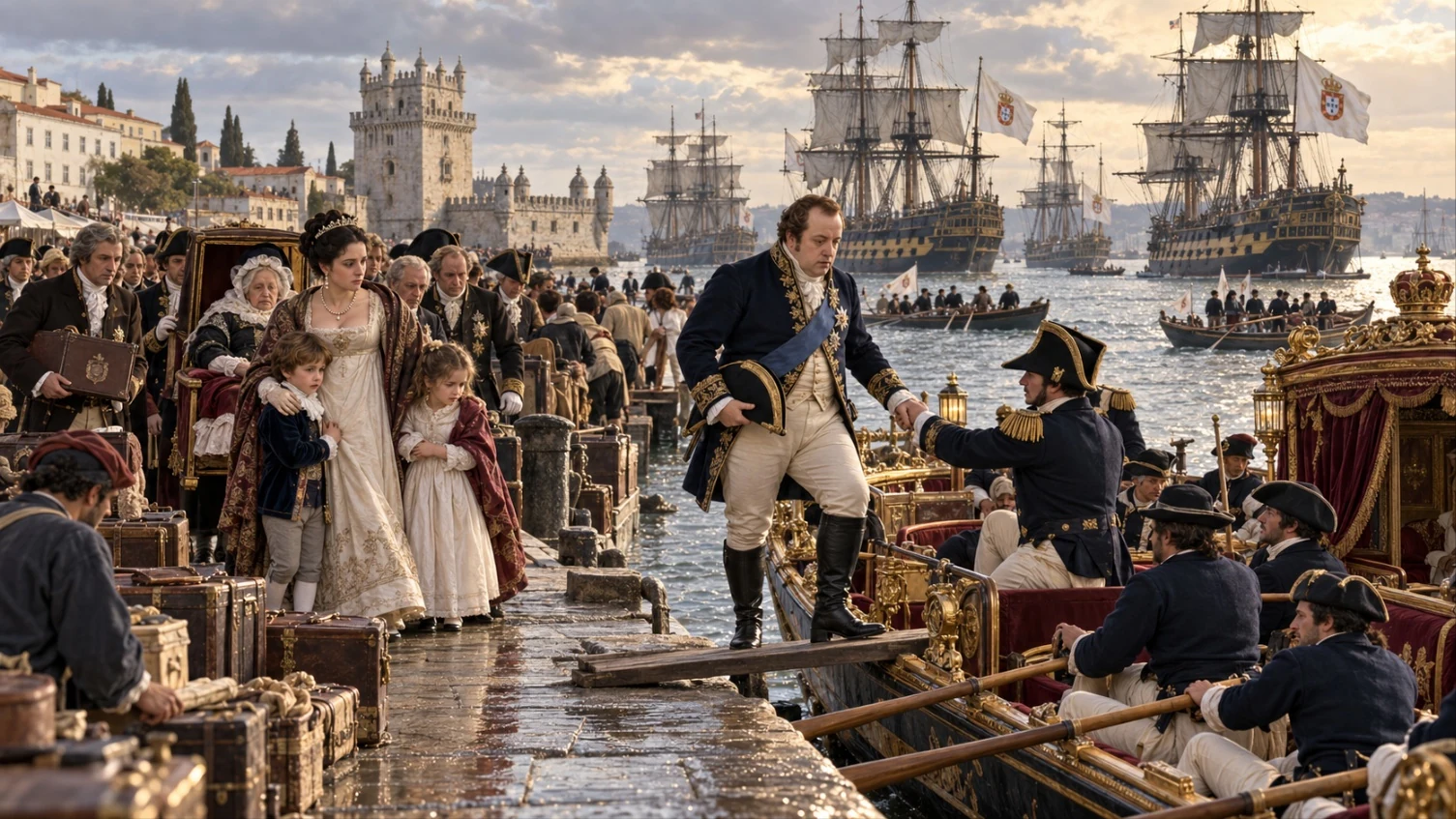 A court boarding ships ahead of an invasion, the pattern of Portugal in 1807. The scene is generic, not a depiction of a specific departure. (AI illustration)
Portugal, 1807–1808: crossing the sea before the capital fell. With a French invasion approaching, the Prince Regent João, along with the royal family and court, crossed to Brazil. They arrived in Salvador in January 1808 and settled in Rio de Janeiro in March. This case is closest to the move to Ganghwa: the dynasty was moved to safety before the capital fell. The difference is that the destination was the country’s own colony across the ocean.
Byzantine Nicaea, 1204: a court rebuilt after the capital was lost. When the Fourth Crusade captured Constantinople, part of the Byzantine elite set up an imperial court again at Nicaea in Asia Minor, and they retook the old capital in 1261. If the move to Ganghwa was meant to protect the capital, Nicaea was a government in exile trying to win back a capital it had lost.
China, Chongqing, from 1937: the people who moved with the government. In November 1937, as the Japanese army advanced, the Nationalist government announced, before Nanjing fell, that it would move its capital to Chongqing. Chongqing then served as the wartime capital. Britannica writes that many government agencies and industries moved there as well, and that Chongqing kept its morale under Japanese bombing but suffered economic problems such as rising prices and corruption. In Goryeo’s case, the royal family, officials, and the powerful moved to Ganghwa; Gaegyeong’s residents were ordered to leave too, though this article could not confirm how many reached the island. People in the provinces were ordered into mountain fortresses and onto islands.
Korea, 1232. Compared with these three cases, the move to Ganghwa resembles Portugal and Nationalist China in that it was chosen before the capital fell. It differs from both in that the power to decide lay not with the king but with a military ruler.
What kind of move a capital relocation is depends on who gets taken along.
Watching episode 27 of Warrior K again
Gojong’s procession out of Gaegyeong looks like the start of a resistance. But in the sources, behind that procession lay an officer dragged from the meeting at Choe U’s house and beheaded, and a capital city posted with notices that anyone who missed the deadline would be dealt with under military law.
The island protected the dynasty. The people on the mainland had to protect themselves.
This article was researched and written by K-Drama History. Source: Warrior K (무신), Explained: Why Did Goryeo Move Its Capital to an Island — and Who Made the Decision? — K-Drama History